Advertisements
Advertisements
प्रश्न
The circuit depicted in the figure is employed to study Ohm's Law. Rather than employing a conventional resistor, a glass tube of length 'l' and cross-sectional area 'a', which is half-filled with mercury of resistivity 'd', is connected to the circuit via two electrodes, E1 and E2. These electrodes are linked to a battery with an emf of 'E' and negligible internal resistance. Provide the answer in terms of 'a', 'l', 'd', and 'E'.
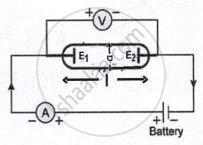
- Resistance of mercury in the tube.
- The ammeter reading.
- Voltmeter reading.
- Which of the measurements are altered when the tube is entirely filled with mercury?
Advertisements
उत्तर
The mercury column fills half the length of the tube, so its length is `l/2` and its cross-sectional area is a.
(a) Resistance of mercury: R = `d(l/2)/a = dl/(2a)`
(b) Ammeter reading: I = `E/R = E ÷ (dl/(2a)) = 2Ea/(dl)`
(c) Voltmeter reading: Since the battery has negligible internal resistance and the voltmeter is connected across the mercury column, it reads the full emf of the battery. Voltmeter reading = E.
(d) When the tube is completely filled with mercury, the length of the mercury column becomes l. So, the new resistance is `dl/a`, and the new current is `Ea/(dl)`. Thus, the resistance and the ammeter reading change, while the voltmeter reading remains E.
