Advertisements
Advertisements
प्रश्न
The basis of the classifications proposed by Dobereiner, Newlands and Mendeleev was ______.
Advertisements
उत्तर
The basis of the classifications proposed by Dobereiner, Newlands and Mendeleev was atomic masses
APPEARS IN
संबंधित प्रश्न
The number of electrons in the outermost shell of alkali metals is ______.
In which block of the modern periodic table are the nonmetals found?
(a) How is possible valency of an element determined from the electronic configuration of its atom ?
(b) Determine the valency of an element X whose atomic number is 15.
How did the early chemists classify elements?
Example for liquid metal is ______.
Among the given species A–, A+, and A, the smallest one in size is ______.
The elements A, B, and C belong to groups 1, 14, and 17 respectively of the Periodic Table. Which two elements will form ionic compounds?
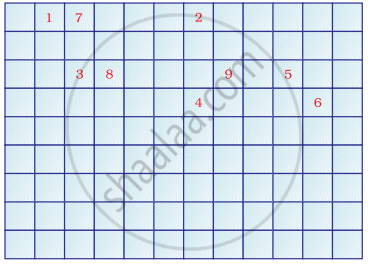
Complete the following cross word puzzle
Across:
(1) An element with atomic number 12.
(3) Metal used in making cans and member of Group 14.
(4) A lustrous non-metal which has 7 electrons in its outermost shell.
Down:
(2) Highly reactive and soft metal which imparts yellow colour when subjected to flame and is kept in kerosene.
(5) The first element of second Period
(6) An element which is used in making fluorescent bulbs and is second member of Group 18 in the Modern Periodic Table
(7) A radioactive element which is the last member of halogen family.
(8) Metal which is an important constituent of steel and forms rust when exposed to moist air.
(9) The first metalloid in Modern Periodic Table whose fibres are used in making bullet-proof vests
Relate the names of the following scientists with the statements given below.
Arranged elements in a group of seven with increasing atomic masses and eighth elements with similar properties kept below the first like eight note in an act of music.
The atomic number of an element 'X' is 11.
- Write the electronic configuration of X and find its valency.
- Write the formula and nature of its oxide.
