Advertisements
Advertisements
प्रश्न
The angles A, B, C and D of a trapezium ABCD are in the ratio 3: 4: 5: 6. Le. ∠A : ∠B : ∠C : ∠D = 3:4: 5 : 6. Find all the angles of the trapezium. Also, name the two sides of this trapezium which are parallel to each other. Give reason for your answer.
Advertisements
उत्तर
As the trapezium ABCD is a quadrilateral,
∴ Sum of its interior angles = 360°
⇒ ∠A + ∠B + ∠C + ∠D = 360°
⇒ 3x + 4x + 5x + 6x = 360°
⇒ 18x = 360°
⇒ x = `360^circ/18 = 20°`
∴ ∠A = 3x = 3 × 20° = 60°
and ∠B = 4x = 4 × 20° = 80°
and ∠C = 5x = 5 × 20° = 100°
and ∠D = 6x = 6 × 20° = 120°
AB is parallel to DC.
∵ ∠A + ∠D = 180°
∠A and ∠D are co-interior angles whose sum = 180°
APPEARS IN
संबंधित प्रश्न
Define the following term Quadrilateral .
Complete of the following, so as to make a true statement:
The sum of the angles of a quadrilateral is ......
Complete of the following, so as to make a true statement:
A diagonal of a quadrilateral is a line segment that joins two ...... vertices of the quadrilateral.
In a convex hexagon, prove that the sum of all interior angle is equal to twice the sum of its exterior angles formed by producing the sides in the same order.
In the given figure, PQRS is an isosceles trapezium. Find x and y.
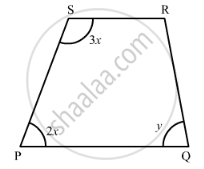
Use the following figure to find the value of x
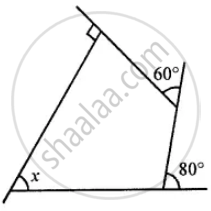
One angle of a pentagon is 160° and the rest are all equal angles. Find the measure of the equal angles.
ABCDE is a pentagon in which AB is parallel to DC and ∠A : ∠E : ∠D = 1 : 2 : 3. Find angle A.
In the figure, PQRS and PTVS are two cyclic quadrilaterals, If ∠QRS = 100°, then ∠TVS =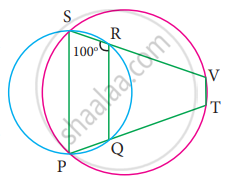
Using the information given, name the right angles in part of figure:
AC ⊥ BD

