Advertisements
Advertisements
प्रश्न
The adjoining diagram shows a line AB. Draw diagram to represent: \[\underrightarrow{BA}\]
Advertisements
उत्तर

संबंधित प्रश्न
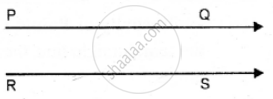
State, whether the following pair of line or ray appear to be parallel or intersecting.
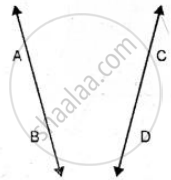
State, whether the following pair of line or ray appear to be parallel or intersecting.
Give two examples, from your surrounding, for the following:
curved surfaces
The adjoining diagram shows a ray AB. Draw diagrams to show the line AB.
The adjoining diagram shows a ray AB. Draw diagrams to show the line AB i.e. \[\underleftrightarrow{AB}\].
State, which of the lines/line- segments are perpendicular to the line PQ:

Check your text book and How many pairs of its edges are parallel to each other?
In figure is given below, write the number of line segments used:

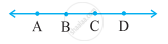
Name the line given in all possible (twelve) ways, choosing only two letters at a time from the four given.
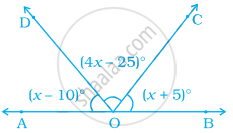
In the following figure, find the value of ∠BOC, if points A, O and B are collinear.