हिंदी
कर्नाटक बोर्ड पी.यू.सी.पीयूसी विज्ञान 2nd PUC Class 12

The activity R of an unknown radioactive nuclide is measured at hourly intervals. The results found are tabulated as follows: - Physics

Advertisements
Advertisements

प्रश्न

The activity R of an unknown radioactive nuclide is measured at hourly intervals. The results found are tabulated as follows:

t (h) 0 1 2 3 4
R (MBq) 100 35.36 12.51 4.42 1.56
  1. Plot the graph of R versus t and calculate the half-life from the graph.
  2. Plot the graph of ln `(R/R_0)` versus t and obtain the value of half-life from the graph.
आलेख
Advertisements

उत्तर

We have listed R(MBq) and In `(R/R_0)` in the table below.

t (h) 0 1 2 3 4
R (MBq) 100 35.36 12.51 4.42 1.56
`R/R_0` – 1.04 – 2.08 – 3.11 – 4.16

i. Graph between R versus t is an exponential curve. From the graph at slightly more than `t = 1/2 h` the R should be 50% so at R = 50% the t(h) = 0.7h

= 0.7 × 60 min

= 42 min
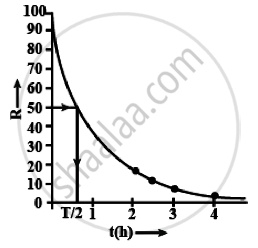

ii. The adjacent figure shows the graph of In `(R/R_0)` versus t.

The slope of this graph = – λ

From the graph,

`λ = - ((-4.16 - 3.11)/1) = 1.05  h^-1`

Hence half-life `T_(1/2) = 0.693/λ  = 0.693/1.05` = 0.66 h

= 39.6 min ≈ 40 min

shaalaa.com
  क्या इस प्रश्न या उत्तर में कोई त्रुटि है?
अध्याय 13: Nuclei - Exercises [पृष्ठ ८५]

APPEARS IN

एनसीईआरटी एक्झांप्लर Physics [English] Class 12
अध्याय 13 Nuclei
Exercises | Q 13.25 | पृष्ठ ८५

वीडियो ट्यूटोरियलVIEW ALL [1]

संबंधित प्रश्न

The decay constant of radioactive substance is 4.33 x 10⁻⁴ per year. Calculate its half life period.


Derive the mathematical expression for law of radioactive decay for a sample of a radioactive nucleus


A radioactive isotope has a half-life of T years. How long will it take the activity to reduce to a) 3.125%, b) 1% of its original value?


The Q value of a nuclear reaction A + b → C + d is defined by

Q = [mA+ mb − mC − md]c2 where the masses refer to the respective nuclei. Determine from the given data the Q-value of the following reactions and state whether the reactions are exothermic or endothermic.

\[\ce{^12_6C + ^12_6C ->^20_10Ne + ^4_2He}\]

Atomic masses are given to be

`"m"(""_1^2"H")` = 2.014102 u

`"m"(""_1^3"H")` = 3.016049 u

`"m"(""_6^12C)` = 12.000000 u

`"m"(""_10^20"Ne")` = 19.992439 u


A radioactive nucleus ‘A’ undergoes a series of decays according to the following scheme:

The mass number and atomic number of A are 180 and 72 respectively. What are these numbers for A4?


A freshly prepared radioactive source of half-life 2 h emits radiation of intensity which is 64 times the permissible safe level. The minimum time after which it would be possible to work safely with this source is


The masses of 11C and 11B are respectively 11.0114 u and 11.0093 u. Find the maximum energy a positron can have in the β*-decay of 11C to 11B.

(Use Mass of proton mp = 1.007276 u, Mass of `""_1^1"H"` atom = 1.007825 u, Mass of neutron mn = 1.008665 u, Mass of electron = 0.0005486 u ≈ 511 keV/c2,1 u = 931 MeV/c2.)


The decay constant of `""_80^197`Hg (electron capture to `""_79^197`Au) is 1.8 × 10⁻⁴ S−1. (a) What is the half-life? (b) What is the average-life? (c) How much time will it take to convert 25% of this isotope of mercury into gold?


A radioactive isotope is being produced at a constant rate dN/dt = R in an experiment. The isotope has a half-life t1/2. Show that after a time t >> t1/2 the number of active nuclei will become constant. Find the value of this constant.


A radioactive substance disintegrates into two types of daughter nuclei, one type with disintegration constant λ1 and the other type with disintegration constant λ2 . Determine the half-life of the radioactive substance.


The isotope \[\ce{^57Co}\] decays by electron capture to \[\ce{^57Fe}\] with a half-life of 272 d. The \[\ce{^57Fe}\] nucleus is produced in an excited state, and it almost instantaneously emits gamma rays.
(a) Find the mean lifetime and decay constant for 57Co.
(b) If the activity of a radiation source 57Co is 2.0 µCi now, how many 57Co nuclei does the source contain?

c) What will be the activity after one year?


A source contains two species of phosphorous nuclei, \[\ce{_15^32P}\] (T1/2 = 14.3 d) and \[\ce{_15^33P}\] (T1/2 = 25.3 d). At time t = 0, 90% of the decays are from \[\ce{_15^32P}\]. How much time has to elapse for only 15% of the decays to be from \[\ce{_15^32P}\]?


Obtain an expression for the decay law of radioactivity. Hence show that the activity A(t) =λNO e-λt.  


After 1 hour, `(1/8)^"th"` of the initial mass of a certain radioactive isotope remains undecayed. The half-life of the isotopes is ______.


Two radioactive materials Y1 and Y2 have decay constants '5`lambda`' and `lambda` respectively. Initially they have same number of nuclei. After time 't', the ratio of number of nuclei of Y1 to that of Y2 is `1/"e"`, then 't' is equal to ______.


The half-life of a radioactive nuclide is 20 hrs. The fraction of the original activity that will remain after 40 hrs is ______.


Draw a graph showing the variation of decay rate with number of active nuclei.


The radioactivity of an old sample of whisky due to tritium (half-life 12.5 years) was found to be only about 4% of that measured in a recently purchased bottle marked 10 years old. The age of a sample is ______ years.


What is the half-life period of a radioactive material if its activity drops to 1/16th of its initial value of 30 years?


The half-life of `""_82^210Pb` is 22.3 y. How long will it take for its activity 0 30% of the initial activity?


Share
Notifications

Englishहिंदीमराठी


      Forgot password?
Use app×