Advertisements
Advertisements
प्रश्न
|
Ten participants, all having a phobia of spiders, were divided into two groups for a study that aimed at determining the effectiveness of Cognitive Behaviour Therapy (CBT) and Systematic Desensitisation. Each group underwent two sessions of each therapy. At the end of every session, the effectiveness of therapies was measured based on a questionnaire on Anxiety, which was filled by the participants. The responses of the participants have been depicted in the graph given below.
|
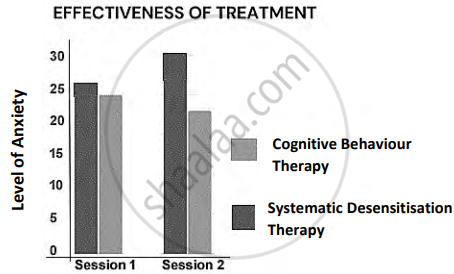
- Refer to the graph shown above and determine which treatment was more effective. Contrast the effectiveness of Cognitive Behaviour Therapy (CBT) and Systematic Desensitisation. (3)
- Discuss any two symptoms and any two causes of Phobias. (4)
दीर्घउत्तर
Advertisements
उत्तर
- The results from the two sessions in the bar graph show that Cognitive Behaviour Therapy (CBT) was more effective in the treatment of the phobia than Systematic Desensitisation.
Cognitive Behaviour therapy involves identifying and changing distorted and maladaptive patterns of thought. Systematic desensitisation involves gradual exposure to an anxiety-producing stimulus that is paired with relaxation in order to eliminate the response of the anxiety-causing phobia. It is a therapy under Classical Conditioning. Systematic Desensitisation. -
- Symptoms of phobia:
- The fear is unreasonable or excessive, but the person is unable to help himself or herself from being rational.
- The phobic situation is avoided otherwise it is endured with great distress.
- It causes personal distress and impaired functioning.
- The anxiety associated with phobias is not related to other psychological disorders.
- Causes of Phobia:
Biological causes of phobias:- Genes: Specific genes may affect anxiety and fearfulness.
- Chemical Imbalance: An imbalance in the brain chemical Serotonin could be a factor. Serotonin, a neurotransmitter, helps regulate mood and emotions, among other functions. People with phobic disorders may be extra sensitive to the effects of serotonin.
- Fear responses: The limbic system of the brain is involved in controlling strong emotions, motivation and learning. The amygdala may play a role in controlling the fear response. People who have an overactive amygdala may have a heightened fear response, causing increased anxiety in social and specific situations.
- Behavioural perspective: explains anxiety in phobic disorders as a learned response to stress. Operant A young girl is bitten by an insect. When she next sees one, she is frightened and runs away - a behaviour that relieves her anxiety and thereby reinforces her avoidance behaviour.
- Classical conditioning: associate neutral stimuli with strong emotional reactions. For example, an individual may develop a phobia of buzzing noises such as those made by bees after being stung by a bee or wasp.
- Social Cognitive view: Observational learning leads to fears typical of phobias. For example, a little girl may have developed a fear of high places because she may have seen or heard of people who were afraid of high places.
- Symptoms of phobia:
shaalaa.com
Childhood - Motor, Cognitive Development, Socio-emotional Development
क्या इस प्रश्न या उत्तर में कोई त्रुटि है?
