Advertisements
Advertisements
प्रश्न
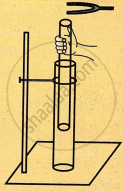
Take two pipes of slightly different diameters, open at both the ends, so that one pipe can be moved freely inside the other. Keep the wider pipe fixed by clamping on a stand and move the other pipe up and down by hand as shown in the accompanying figure. Use a tuning fork of frequency 320 Hz or 288 Hz and keep it above the open end of the fixed pipe. Move the inner tube and try to hear the various sound patterns and write down your observations. Try to analyze the results based on the knowledge you have from the sound pattern formed with a pipe open at both ends.
Advertisements
उत्तर
When the inner pipe is moved up and down, the effective length of the air column changes. At certain lengths, the frequency of the air column becomes equal to the frequency of the tuning fork and resonance occurs, producing a loud sound.
For a pipe open at both ends, resonance occurs when,
L = `(n lambda)/2`, n = 1, 2, 3, .....
So, successive resonant lengths differ by,
`lambda/2`
Hence, by noting the positions where the sound becomes loud, we can study the standing wave pattern in an open pipe and determine the wavelength of sound.
