Advertisements
Advertisements
प्रश्न
Supply the missing word from those in bracket:
If an element has one electron in its outermost energy level [shell] then it is likely to be _______.
विकल्प
metallic
non- metallic
Advertisements
उत्तर
If an element has one electron in its outermost energy level [shell] then it is likely to be metallic.
APPEARS IN
संबंधित प्रश्न
List any two properties of the elements belonging to the first group of the modern periodic table.
How do the valency and the atomic size of the elements vary while going from left to right along a period in the modern periodic table?
Consider two elements 'A' (Atomic number 17) and 'B' (Atomic number 19) :
(i) Write the positions of these elements in the modern periodic table giving justification.
(ii) Write the formula of the compound formed when 'A' combines with 'B.'
(iii) Draw the electron dot structure of the compound and state the nature of the bond formed between the two elements.
Use the letters only written in the Periodic Table given below to answer the questions that Follow:
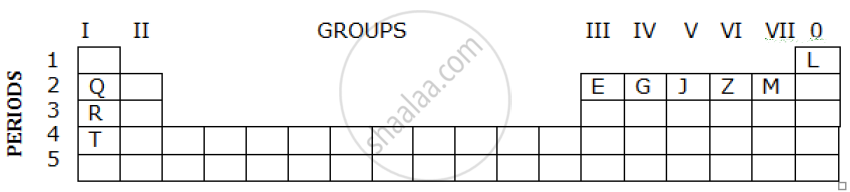
- State the number of valence electrons in atom J.
- Which element shown forms ions with a single negative charge?
- Which metallic element is more reactive than R?
- Which element has its electrons arranged in four shells?
Five elements A, B, C, D and E have atomic numbers of 2, 3, 7, 10 and 18 respectively. The elements which belong to the same period of the periodic table are:
(a) A, B, C
(b) B, C, D
(c) A, D, E
(d) B, D, E
Which of the following is the valence shell for the elements of second period of the modern periodic table?
(a) M shell
(b) K shell
(c) L shell
(d) N shell
Which one of the following does not increase while moving down the group of the periodic table?
In each of the following pair, choose the atom having the bigger size:
(a) Mg (At. No.12) or Cl (At. No.17)
With reference to the variation of properties in the Periodic table, which of the following is generally true?
The position of elements A, B, C, D and E in the periodic table are shown below:
|
Group 1 |
Group 2 |
Group 17 |
Group 18 |
|
|
|
|
D |
|
|
B |
C |
|
|
A |
|
|
E |
Which is larger in size (i) D or E (ii) B or C
