Advertisements
Advertisements
प्रश्न
Study the picture and answer the following questions:
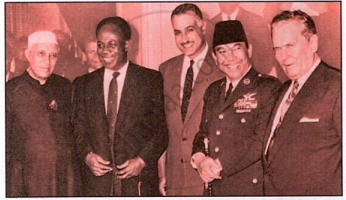
- Identify at least three persons in the picture. Name the organisation with which these persons were associated.
- Where was this organisation formed? State any three objectives of this organisation.
- Has this organisation been able to achieve its objectives? Give reasons for your answer.
विस्तार में उत्तर
Advertisements
उत्तर
- Identification and Organisation:
- Persons:
- Jawaharlal Nehru (Prime Minister of India)
- Kwame Nkrumah (President of Ghana)
- Gamal Abdel Nasser (President of Egypt)
- Sukarno (President of Indonesia)
- Josip Broz Tito (President of Yugoslavia)
- Associated Organisation: They were the founding leaders of the Non-Aligned Movement (NAM).
- Persons:
- Formation and Objectives:
- Formation: The organisation was officially formed at its First Summit in Belgrade, Yugoslavia, in 1961 (following the preparatory Bandung Conference in Indonesia in 1955).
- Objectives:
- Oppose Colonialism and Imperialism: To firmly stand against foreign rule, neo-colonialism, and racial discrimination (like Apartheid) across the world.
- Maintain Sovereign Independence: To protect the political freedom, territorial boundaries, and sovereign decision-making rights of newly independent nations from superpower interference.
- Promote World Peace and Disarmament: To actively campaign against the Cold War arms race, push for nuclear disarmament, and settle international disputes through peaceful diplomacy.
- Achievements of the Organisation:
Yes, the organisation has partially achieved its goals, but it faces clear limitations.- Reasons for Success (Achievements):
- End of Colonialism: NAM successfully accelerated the decolonisation process, helping numerous Asian and African nations gain independence.
- Prevented Bloc Hegemony: It provided a vital third choice to developing nations, allowing them to remain independent without succumbing to the pressure of joining the US or Soviet power blocs.
- Reasons for Failure (Limitations):
- Inability to Prevent Local Wars: It failed to prevent conflicts among its own member states, such as the Iran-Iraq War or the Sino-Indian War.
- Lack of Consensus: Due to its massive size (120 members), the movement has struggled to maintain unity and has remained largely inactive in resolving major modern conflicts like the Russia-Ukraine war.
- Reasons for Success (Achievements):
shaalaa.com
क्या इस प्रश्न या उत्तर में कोई त्रुटि है?
