Advertisements
Advertisements
प्रश्न
Study the adjoining diagram carefully and calculate:
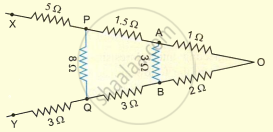
- Equivalent resistance between points A and B.
- Equivalent resistance between points P and Q.
- Equivalent resistance between points X and Y.
Advertisements
उत्तर
From the diagram, each resistor is 2 Ω.
(i) Between A and B:
The triangular loop has a direct 2 Ω resistor between A and B.
Another path A-C-B is made of two 2 Ω resistors in series.
\[ \text{Series resistance} = 2 + 2 \]
\[ = 4 \ \Omega \]
These two paths are in parallel, so:
\[ \mathrm{R}_{AB} = \frac{2 \times 4}{2 + 4} \]
\[ = \frac{8}{6} \]
\[ = \frac{4}{3} \ \Omega \]
(ii) Between P and Q:
There is a direct 2 Ω resistor between P and Q.
The other path is P-A-B-Q:
\[ \text{P-A} = 2 \ \Omega \]
\[ \text{A-B equivalent} = \frac{4}{3} \ \Omega \]
\[ \text{B-Q} = 2 \ \Omega \]
\[ \text{Series resistance} = 2 + \frac{4}{3} + 2 \]
\[ = \frac{16}{3} \ \Omega \]
So, \[ \mathrm{R}_{PQ} = \frac{2 \times \frac{16}{3}}{2 + \frac{16}{3}} \]
\[ = \frac{\frac{32}{3}}{\frac{22}{3}} \]
\[ = \frac{32}{22} \]
\[ = \frac{16}{11} \ \Omega \]
(iii) Between X and Y:
There is a direct 2 Ω resistor between X and Y.
The other path is X-P-Q-Y:
\[ \text{X-P} = 2 \ \Omega \]
\[ \text{P-Q equivalent} = \frac{16}{11} \ \Omega \]
\[ \text{Q-Y} = 2 \ \Omega \]
\[ \text{Series resistance} = 2 + \frac{16}{11} + 2 \]
\[ = \frac{60}{11} \ \Omega \]
So, \[ \mathrm{R}_{XY} = \frac{2 \times \frac{60}{11}}{2 + \frac{60}{11}} \]
\[ = \frac{\frac{120}{11}}{\frac{82}{11}} \]
\[ = \frac{120}{82} \]
\[ = \frac{60}{41} \ \Omega \]
