Advertisements
Advertisements
प्रश्न
Study the adjoining diagram carefully and answer the following questions:
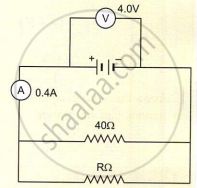
- By using the reading of voltmeter and ammeter, calculate the equivalent resistance of 40 Ω and R.
- Calculate the value of R.
- Calculate the current flowing through R.
Advertisements
उत्तर
(i) Equivalent resistance:
The voltmeter reads the potential difference across the parallel combination, and the ammeter reads the total current.
\[ \mathrm{R}_{eq} = \frac{\mathrm{V}}{\mathrm{I}} \]
\[ = \frac{4.0 \ \text{V}}{0.4 \ \text{A}} \]
\[ = 10 \ \Omega \]
(ii) Value of R:
For resistors in parallel:
\[ \frac{1}{\mathrm{R}_{eq}} = \frac{1}{40 \ \Omega} + \frac{1}{\mathrm{R}} \]
\[ \frac{1}{10} = \frac{1}{40} + \frac{1}{\mathrm{R}} \]
\[ \frac{1}{\mathrm{R}} = \frac{1}{10} - \frac{1}{40} \]
\[ = \frac{4 - 1}{40} \]
\[ = \frac{3}{40} \]
\[ \therefore \mathrm{R} = \frac{40}{3} \ \Omega \]
\[ \approx 13.3 \ \Omega \]
(iii) Current through R:
Both resistors in parallel have the same potential difference, which is 4.0 V.
\[ \mathrm{I}_{R} = \frac{\mathrm{V}}{\mathrm{R}} \]
\[ = \frac{4.0}{\frac{40}{3}} \]
\[ = \frac{4.0 \times 3}{40} \]
\[ = 0.3 \ \text{A} \]
Therefore, the current flowing through R is 0.3 A.
