Advertisements
Advertisements
प्रश्न
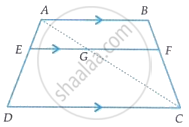
State the converse of basic proportionality theorem. Also, find `(BF)/(FC)` in figure, given that AB || DC || EF and `(AE)/(ED) = 2/3`. Also, find the length of EF if AB = 10 cm and DC = 15 cm.
Advertisements
उत्तर
Given:
AB || DC || EF, points E on AD and F on BC and `(AE)/(ED) = 2/3`.
AB = 10 cm, DC = 15 cm.
Step-wise calculation:
1. Converse (Basic Proportionality Theorem):
If a line divides two sides of a triangle in the same ratio, then the line is parallel to the third side (Theorem 6.2).
2. Find `(BF)/(FC)`:
Join AC; let AC meet EF at G. Because EF || DC and EF || AB, by the Basic Proportionality Theorem we get `(AE)/(ED) = (AG)/(GC)` and also `(AG)/(GC) = (BF)/(FC)` same argument applied in the two relevant triangles.
Hence `(AE)/(ED) = (BF)/(FC)`.
Substitute `(AE)/(ED) = 2/3` → `(BF)/(FC) = 2/3`.
3. Find EF:
AE : ED = 2 : 3
⇒ AD = AE + ED = 2k + 3k = 5k, so `(AE)/(AD) = 2/5`.
Length of a segment parallel to AB and DC at a point which divides AD in fraction `t = (AE)/(AD)` is the linear interpolation between AB and DC : EF = AB + t · (DC – AB), where `t = (AE)/(AD) = 2/5`.
Compute: `EF = 10 + 2/5 xx (15 - 10)`
= `10 + 2/5 xx 5`
= 10 + 2
= 12 cm
