Advertisements
Advertisements
प्रश्न
Ram is a student of class X in a village school. His uncle gifted him a bicycle with a dynamo fitted in it. He was very excited to get it. While cycling during night, he could light the bulb and see the objects on the road. He, however, did not know how this device works. he asked this question to his teacher. The teacher considered it an opportunity to explain the working to the whole class.
Answer the following questions:
(a) State the principle and working of a dynamo.
(b) Write two values each displayed by Ram and his school teacher.
Advertisements
उत्तर
(a) The underlying principle in the working of a dynamo is that changing magnetic flux in a conductor induces emf. A dynamo includes a coil attached to a small turbine fitted with a plastic cap. The coil is placed in a magnetic field. When the plastic cap comes in contact with moving tyres of the bicycle, the coil placed between the poles of a magnet rotates, thus the flux through the coil changes continuously. This induces a current in the coil which is connected to a bulb which lights up. As long as the bicycle is moving, the coil keeps on rotating, and hence, the flux keeps on changing. At a steady rate, we get a steady current and hence a light of steady intensity.
(b) The qualities shown by the teacher are: helpful and responsible as a teacher, and knowledgeable. The qualities shown by Ram are inquisitive and observing.
APPEARS IN
संबंधित प्रश्न
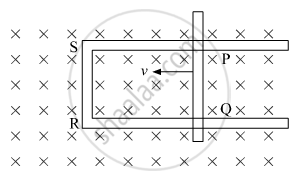
Figure shows a rectangular loop conducting PQRS in which the arm PQ is free to move. A uniform magnetic field acts in the direction perpendicular to the plane of the loop. Arm PQ is moved with a velocity v towards the arm Rs. Assuming that the arms QR, RS and SP have negligible resistances and the moving arm PQ has the resistance r, obtain the expression for (i) the current in the loop (ii) the force and (iii) the power required to move the arm PQ.
Whenever the magnetic flux linked with an electric circuit changes, an emf is induced in the circuit. This is called ______.
The magnetic flux linked with a coil of N turns of area of cross-section A held with its plane parallel to the field B is ______.
The dimensions of magnetic flux are ______
Which symbol represents magnetic flux?
What does \[\vec A\] represent in the magnetic flux formula?
What happens to magnetic flux when magnetic field \[B\] increases while area and orientation remain unchanged?
What is associated with electromagnetic induction?
Which expression is Gauss's Law for Magnetism?
