Advertisements
Advertisements
प्रश्न
State how does the time period of a simple pendulum depend on (a) length of pendulum, (b) mass of bob, (c) amplitude of oscillation and (d) acceleration due to gravity.
Advertisements
उत्तर
(a) The time period of oscillations is directly proportional to the square root of the length of the pendulum.
(b) The time period of oscillations of simple pendulum does not depend on the mass of the bob.
(c) The time period of oscillations of simple pendulum does not depend on the amplitude of oscillations.
(d) The time period of oscillations of simple pendulum is inversely proportional to the square root of acceleration due to gravity.
APPEARS IN
संबंधित प्रश्न
How is the time period of a simple pendulum affected, if at all, in the following situations:
- The length is made four times.
- The acceleration due to gravity is reduced to one-fourth.
Two simple pendulums A and B have lengths 1.0 m and 4.0 m, respectively, at a certain place. Which pendulum will make more oscillations in 1 min? Explain your answer.
Explain the two ways by which the pitch of the sound generated by a stretched string can be changed.
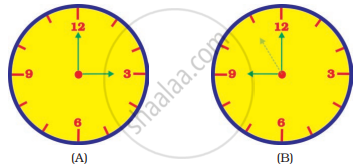
Two clocks A and B are shown in the following figure. Clock A has an hour and a minute hand, whereas clock B has an hour hand, a minute hand as well as a second hand. Which of the following statement is correct for these clocks?
Give scientific reason.
In earlier times, people used to listen for the arrival of a distant train by putting their ear to the rail.
Give scientific reason.
In earlier times, people used to listen for the arrival of a distant train by putting their ear to the rail.
Give scientific reason.
In earlier times, people used to listen for the arrival of a distant train by putting their ear to the rail.
Give scientific reasons.
In earlier times, people used to listen for the arrival of a distant train by putting their ear to the rail.
Give scientific reason.
In earlier times, people used to listen for the arrival of a distant train by putting their ear to the rail.
Give scientific reason.
In earlier times, people used to listen for the arrival of a distant train by putting their ear to the rail.
