Advertisements
Advertisements
प्रश्न
Some hunters are roaming in the plush green forest of Africa. They spot a deer and kill it. They decide to roast the deer there and then and eat it. When the hunters had just finished enjoying the feast of roasted deer, a lion attacks them. The lion kills one of the hunters and eats his flesh.
(a) write a food chain which provides food to lion in this case.
(b) Which animal (other than deer) the lion could look for food if he did not get the hunter as prey?
(c) Which other animal in the forest could have been in place of lion?
(d) How does the above food chain differ form the food chain such as : plants → goat → man?
Advertisements
उत्तर
(a) The following is the food chain that provides food to the lion in the given case:
Plants→Deer→Man → Lion
(b) The lion could have looked for a herbivore, such a wild buffalo or a zebra, if it he had not got the hunter as prey.
(c) Any top consumer, such as a tiger or a python, could have been in the place of the lion in the forest.
(d) In the food chain,
Plants→ Goat→ Man
man is the top consumer whereas, in the food chain,
Plants→ Deer→ Man→ Lion,
the top consumer is lion.
APPEARS IN
संबंधित प्रश्न
What are planktons?
Give an example of a four step food chain operating in grassland. Name the secondary consumer in this food chain
What will happen if we kill all the organisms in one trophic level?
Write down a food chain with five links in it.
In a food chain, the third trophic level is always occupied by :
(a) carnivores
(b) herbivores
(c) decomposers
(d) producers
Which of the following group of organisms are not constituents of a food chain?
- grass, lion, rabbit, wolf
- plankton, man, fish, grasshopper
- wolf, grass, snake, tiger
- frog, snake, eagle, grass, grasshopper
A food chain occurring in the sea which provides food for many people can be written as :
phytoplankton → zooplankton → X → Y
Name two zooplanktons.
What would happen to the number of grass plants and foxes if the number of rabbits decreased?
Match the terms given in column I with the terms given in column II and column III having the same meaning :
| Column I | Column II | Column III |
| (1) Secondary consumer | Herbivore | 1st trophic level |
| (2) Primary consume | Autotroph | 3rd trophic level |
| (3) Producer | Carnivore | 4th trophic level |
| (4) Tertiary consumer | Large carnivore | 2nd trophic level |
Fill in the following blank with suitable word :
Pesticides enter the food chain at the ...........level
Explain why, a food chain usually cannot have more than three or four steps.
What provides the energy which then flows through a food chain?
(a) glucose
(b) oxygen
(c) respiration
(d) sunlight
The ten per cent law is associated with
(a) transfer of energy from various trophic levels to decomposers in a food chain
(b) transfer of ATP energy into muscular energy
(c) transfer of chemical energy from one organism to another
(d) transfer of sun's energy to the organisms called producers.
A food chain consists of fish, larvae, phytoplanktons and birds. The level of pesticides in water in which the fish, larvae and phytoplanktons live is quite high.
(a) In which organisms the pesticides enter from the polluted water? What is this level of organisms known as?
We should reduce the use of the plastic bags, bottles etc. because ______.
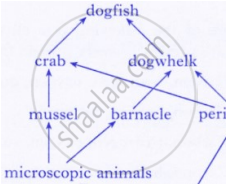
Observe the food web and answer the questions given below:
Why do all food chains start with plants?
______ obtained energy from the chemical breakdown of dead organisms.
In the given food chain, suppose the amount of energy at the fourth trophic level is 5 kJ, what will be the energy available at the producer level?
Grass → Grasshopper → Frog → Snake → Hawk
In the following food chain, only 2J of energy was available to the peacocks. How much energy would have been present in Grass? Justify your answer.
GRASS → GRASS HOPPER → FROG → SNAKE → PEACOCK
Which of the following statements is correct?
