Advertisements
Advertisements
प्रश्न
Solve the following simultaneous equation.
x − 2y = −2 ; x + 2y = 10
Advertisements
उत्तर
x − 2y = −2 ...(I)
x + 2y = 10 ...(II)
Adding (I) and (II)
x − 2y = −2
+ x + 2y = 10
2x = 8
⇒ x = 4
Putting the value of x in (I) we get
∴ x - 2y = −2
⇒ 4 − 2y = −2
⇒ −2y = −6
⇒ y = 3
APPEARS IN
संबंधित प्रश्न
Solve the following system of linear equations by using the method of elimination by equating the coefficients: 3x + 4y = 25 ; 5x – 6y = – 9
Solve the following system of equations by using the method of elimination by equating the co-efficients.
`\frac { x }{ y } + \frac { 2y }{ 5 } + 2 = 10; \frac { 2x }{ 7 } – \frac { 5 }{ 2 } + 1 = 9`
Solve the following system of linear equations by using the method of elimination by equating the coefficients √3x – √2y = √3 = ; √5x – √3y = √2
Solve (a – b) x + (a + b) y = `a^2 – 2ab – b^2 (a + b) (x + y) = a^2 + b^2`
Solve the following pair of linear equation by the elimination method and the substitution method.
`x/2 + (2y)/3 = -1 and x - y /3 = 3`
Two types of boxes A, B are to be placed in a truck having a capacity of 10 tons. When 150 boxes of type A and 100 boxes of type B are loaded in the truck, it weighes 10 tons. But when 260 boxes of type A are loaded in the truck, it can still accommodate 40 boxes of type B, so that it is fully loaded. Find the weight of each type of box.
The sum of the digits in a two-digits number is 9. The number obtained by interchanging the digits exceeds the original number by 27. Find the two-digit number.
Solve the following simultaneous equation.
`2/x + 3/y = 13` ; `5/x - 4/y = -2`
By equating coefficients of variables, solve the following equations.
3x - 4y = 7; 5x + 2y = 3
By equating coefficients of variables, solve the following equation.
x − 2y = −10 ; 3x − 5y = −12
A fraction becomes `(1)/(3)` when 2 is subtracted from the numerator and it becomes `(1)/(2)` when 1 is subtracted from the denominator. Find the fraction.
The difference between an angle and its complement is 10° find measure of the larger angle.
Complete the activity.
The sum of the two-digit number and the number obtained by interchanging the digits is 132. The digit in the ten’s place is 2 more than the digit in the unit’s place. Complete the activity to find the original number.
Activity: Let the digit in the unit’s place be y and the digit in the ten’s place be x.
∴ The number = 10x + y
∴ The number obtained by interchanging the digits = `square`
∴ The sum of the number and the number obtained by interchanging the digits = 132
∴ 10x + y + 10y + x = `square`
∴ x + y = `square` ...(i)
By second condition,
Digit in the ten’s place = digit in the unit’s place + 2
∴ x – y = 2 ...(ii)
Solving equations (i) and (ii)
∴ x = `square`, y = `square`
Ans: The original number = `square`
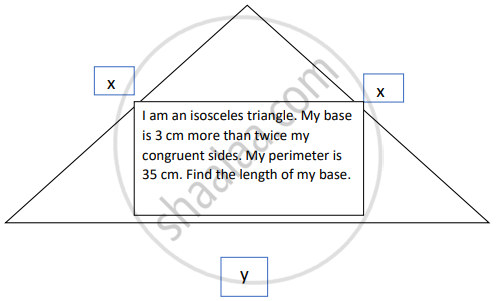
The length of the rectangle is 5 more than twice its breadth. The perimeter of a rectangle is 52 cm, then find the length of the rectangle.
The semi perimeter of a rectangular shape garden is 36 m. The length of the garden is 4 m more than its breadth. Find the length and the breadth of the garden.
The sum of the digits of a two-digit number is 9. If 27 is added to it, the digits of the number get reversed. The number is ______.
Evaluate: (1004)3
The ratio of two numbers is 2:3. If 5 is added in each numbers, then the ratio becomes 5:7 find the numbers.
The ratio of two numbers is 2:3.
So, let the first number be 2x and the second number be `square`.
From the given condition,
`((2x) + square)/(square + square) = square/square`
`square (2x + square) = square (square + square)`
`square + square = square + square`
`square - square = square - square`
`- square = - square`
x = `square`
So, The first number = `2 xx square = square`
and, Second number = `3 xx square = square`
Hence, the two numbers are `square` and `square`
Read the following passage:
Two schools 'P' and 'Q' decided to award prizes to their students for two games of Hockey ₹ x per student and Cricket ₹ y per student. School 'P' decided to award a total of ₹ 9,500 for the two games to 5 and 4 Students respectively; while school 'Q' decided to award ₹ 7,370 for the two games to 4 and 3 students respectively. |
Based on the above information, answer the following questions:
- Represent the following information algebraically (in terms of x and y).
- (a) What is the prize amount for hockey?
OR
(b) Prize amount on which game is more and by how much? - What will be the total prize amount if there are 2 students each from two games?
