हिंदी

Solve the following problem : A company manufactures bicyles and tricycles, each of which must be processed through two machines A and B Maximum availability of machine A and B is respectively 120 a - Mathematics and Statistics

Advertisements
Advertisements

प्रश्न

Solve the following problem :

A company manufactures bicyles and tricycles, each of which must be processed through two machines A and B Maximum availability of machine A and B is respectively 120 and 180 hours. Manufacturing a bicycle requires 6 hours on machine A and 3 hours on machine B. Manufacturing a tricycle requires 4 hours on machine A and 10 hours on machine B. If profits are ₹ 180 for a bicycle and ₹ 220 on a tricycle, determine the number of bicycles and tricycles that should be manufacturing in order to maximize the profit.

आलेख
योग
Advertisements

उत्तर

Let x number of bicycles and y number of tricycles be manufactured by the company.
∴ Total profit Z = 180x + 220y
This is the objective function to be maximized.
The given information can be tabulated as shown below:

  Bicycles
(x)
Tricycles
(y)
Maximum availability of time (hrs)
Machine A 6 4 120
Machine B 3 10 180

∴ The constraints are 6x + 4y ≤ 120, 3x + 10y ≤ 180, x ≥ 0, y ≥ 0
∴ Given problem can be formulated as
Maximize Z = 180x + 220y
Subject to, 6x + 4y ≤ 120, 3x + 10y ≤ 180 , x ≥ 0, y ≥ 0.
To draw the feasible region, construct the table as follows:

Inequality 6x + 4y ≤ 120 3x + 10y ≤ 180
Corresponding equation (of line) 6x + 4y = 120 3x + 10y = 180
Intersection of line with X-axis (20, 0) (60, 0)
Intersection of line with Y-axis (0, 30) (0, 18)
Region Origin side Origin side

Shaded portion OABC is the feasible region,
whose vertices are O ≡ (0, 0), A ≡ (20, 0), B and C ≡ (0, 18)
B is the point of intersection of the lines 3x + 10y = 180 and 6x + 4y = 120.
Solving the above equations, we get
B ≡ (10, 15)
Here the objective function is,
Z = 180x + 220y
∴ Z at O(0, 0) = 180(0) + 220(0) = 0
Z at A(20, 0) = 180(20) + 220(0) = 3600
Z at B(10, 15) = 180(10) + 220(15) = 5100
Z at C(0, 18) = 180(0) + 220(18) = 3960
∴ Z has maximum value 5100 at B(10, 15)
∴ Z is maximum when x = 10, y = 15
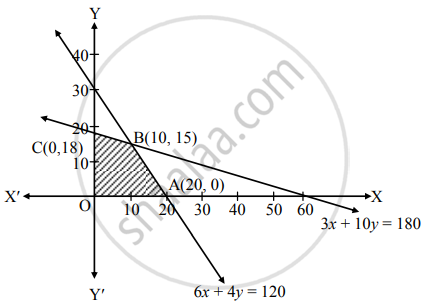
Thus, the company should manufacture 10 bicycles and 15 tricycles to gain maximum profit of ₹ 5100.

shaalaa.com
  क्या इस प्रश्न या उत्तर में कोई त्रुटि है?
अध्याय 6: Linear Programming - Miscellaneous Exercise 6 [पृष्ठ १०४]

APPEARS IN

बालभारती Mathematics and Statistics 2 (Commerce) [English] Standard 12 Maharashtra State Board
अध्याय 6 Linear Programming
Miscellaneous Exercise 6 | Q 4.09 | पृष्ठ १०४

संबंधित प्रश्न

A firm manufactures 3 products AB and C. The profits are Rs 3, Rs 2 and Rs 4 respectively. The firm has 2 machines and below is the required processing time in minutes for each machine on each product : 

Machine Products
A B C
M1
M2
4 3 5
2 2 4

Machines M1 and M2 have 2000 and 2500 machine minutes respectively. The firm must manufacture 100 A's, 200 B's and 50 C's but not more than 150 A's. Set up a LPP to maximize the profit.


Solve the following L.P.P. by graphical method :

Maximize : Z = 7x + 11y subject to 3x + 5y ≤ 26, 5x + 3y ≤ 30, x ≥ 0, y ≥ 0.


Solve the following L.P.P. by graphical method:

Maximize: Z = 10x + 25y
subject to 0 ≤ x ≤ 3,
0 ≤ y ≤ 3,
x + y ≤ 5.
Also find the maximum value of z.


Solve the following L.P.P. by graphical method :

Minimize : Z = 7x + y subject to 5x + y ≥ 5, x + y ≥ 3, x ≥ 0, y ≥ 0.


Choose the correct alternative:

The value of objective function is maximize under linear constraints.


Solve the following problem :

Minimize Z = 2x + 3y Subject to x – y ≤ 1, x + y ≥ 3, x ≥ 0, y ≥ 0


Solve the following problem :

A Company produces mixers and processors Profit on selling one mixer and one food processor is ₹ 2000 and ₹ 3000 respectively. Both the products are processed through three machines A, B, C The time required in hours by each product and total time available in hours per week on each machine are as follows:

Machine/Product Mixer per unit Food processor per unit Available time
A 3 3 36
B 5 2 50
C 2 6 60

How many mixers and food processors should be produced to maximize the profit?


Solve the following problem :

A firm manufacturing two types of electrical items A and B, can make a profit of ₹ 20 per unit of A and ₹ 30 per unit of B. Both A and B make use of two essential components, a motor and a transformer. Each unit of A requires 3 motors and 2 transformers and each unit of B requires 2 motors and 4 transformers. The total supply of components per month is restricted to 210 motors and 300 transformers. How many units of A and B should be manufacture per month to maximize profit? How much is the maximum profit?


Choose the correct alternative:

The maximum value of Z = 3x + 5y subjected to the constraints x + y ≤ 2, 4x + 3y ≤ 12, x ≥ 0, y ≥ 0 is


Choose the correct alternative:

The point at which the minimum value of Z = 8x + 12y subject to the constraints 2x + y ≥ 8, x + 2y ≥ 10, x ≥ 0, y ≥ 0 is obtained at the point


Choose the correct alternative:

The corner points of feasible region for the inequations, x + y ≤ 5, x + 2y ≤ 6, x ≥ 0, y ≥ 0 are


Choose the correct alternative:

The corner points of the feasible region are (0, 3), (3, 0), (8, 0), `(12/5, 38/5)` and (0, 10), then the point of maximum Z = 6x + 4y = 48 is at


State whether the following statement is True or False:

Of all the points of feasible region, the optimal value is obtained at the boundary of the feasible region


State whether the following statement is True or False:

The point (6, 4) does not belong to the feasible region bounded by 8x + 5y ≤ 60, 4x + 5y ≤ 40, 0 ≤ x, y


State whether the following statement is True or False:

The graphical solution set of the inequations 0 ≤ y, x ≥ 0 lies in second quadrant


A set of values of variables satisfying all the constraints of LPP is known as ______


If the feasible region is bounded by the inequations 2x + 3y ≤ 12, 2x + y ≤ 8, 0 ≤ x, 0 ≤ y, then point (5, 4) is a ______ of the feasible region


Maximize Z = 400x + 500y subject to constraints

x + 2y ≤ 80, 2x + y ≤ 90, x ≥ 0, y ≥ 0


Minimize Z = 24x + 40y subject to constraints

6x + 8y ≥ 96, 7x + 12y ≥ 168, x ≥ 0, y ≥ 0


Solve the LPP graphically:
Minimize Z = 4x + 5y
Subject to the constraints 5x + y ≥ 10, x + y ≥ 6, x + 4y ≥ 12, x, y ≥ 0

Solution: Convert the constraints into equations and find the intercept made by each one of it.

Inequations Equations X intercept Y intercept Region
5x + y ≥ 10 5x + y = 10 ( ___, 0) (0, 10) Away from origin
x + y ≥ 6 x + y = 6 (6, 0) (0, ___ ) Away from origin
x + 4y ≥ 12 x + 4y = 12 (12, 0) (0, 3) Away from origin
x, y ≥ 0 x = 0, y = 0 x = 0 y = 0 1st quadrant

∵ Origin has not satisfied the inequations.

∴ Solution of the inequations is away from origin.

The feasible region is unbounded area which is satisfied by all constraints.

In the figure, ABCD represents

The set of the feasible solution where

A(12, 0), B( ___, ___ ), C ( ___, ___ ) and D(0, 10).

The coordinates of B are obtained by solving equations

x + 4y = 12 and x + y = 6

The coordinates of C are obtained by solving equations

5x + y = 10 and x + y = 6

Hence the optimum solution lies at the extreme points.

The optimal solution is in the following table:

Point Coordinates Z = 4x + 5y Values Remark
A (12, 0) 4(12) + 5(0) 48  
B ( ___, ___ ) 4( ___) + 5(___ ) ______ ______
C ( ___, ___ ) 4( ___) + 5(___ ) ______  
D (0, 10) 4(0) + 5(10) 50  

∴ Z is minimum at ___ ( ___, ___ ) with the value ___


A linear function z = ax + by, where a and b are constants, which has to be maximised or minimised according to a set of given condition is called a:-


Shraddho wants to invest at most ₹ 25,000/- in saving certificates and fixed deposits. She wants to invest at least ₹ 10,000/- in saving certificate and at least ₹ 15,000/- in fixed deposits. The rate of interest on saving certificate is 5% and that on fixed deposits is 7% per annum. Formulate the above problem as LPP to determine maximum income yearly.


Share
Notifications

Englishहिंदीमराठी


      Forgot password?
Use app×