Advertisements
Advertisements
प्रश्न
Solve the following equation by factorization
`a/(ax - 1) + b/(bx - 1) = a + b, a + b ≠ 0, ab ≠ 0`
Advertisements
उत्तर
`a/(ax - 1) + b/(bx - 1) = a + b, a + b ≠ 0, ab ≠ 0`
⇒ `(a/(ax - 1) - b) + (b/(bx - 1) - a)` = 0
⇒ `(a - abx + b)/((ax - 1)) + (b - abx + a)/((bx - 1))` = 0
⇒ `(a + b - abx) [1/(ax - 1) + 1/(bx - 1)]` = 0
⇒ `(a + b - abx) [(bx - 1 + ax - 1)/((ax - 1)(bx - 1))]` = 0
⇒ `((a + b - abx)(ax + bx - 2))/((ax - 1)(bx - 1)` = 0
⇒ `(a + b - abx) (ax + bx - 2)` = 0
⇒ Either a + b - abx = 0,
then a+ b = abx
x = `(a + b)/(ab)`
or
ax + bx - 2 = 0,
then x(a + b) = 2
x = `(2)/(a + b)`
Hence x = `(a + b)/(ab), (2)/(a + b)`.
APPEARS IN
संबंधित प्रश्न
The difference of two numbers is 4. If the difference of their reciprocals is `4/21`, find the numbers.
The difference of squares of two numbers is 180. The square of the smaller number is 8 times the larger number. Find two numbers.
If \[\left( a^2 + b^2 \right) x^2 + 2\left( ab + bd \right)x + c^2 + d^2 = 0\] has no real roots, then
Solve the following equation: `("x" + 3)/("x" - 2) - (1 - "x")/"x" = 17/4`
Solve the following equation :
`("x" - 1)/("x" - 2) + ("x" - 3)/("x" - 4) = 3 1/3`
Solve the following by reducing them to quadratic form:
`sqrt(x^2 - 16) - (x - 4) = sqrt(x^2 - 5x + 4)`.
Solve the following equation by factorization
4x2 = 3x
Mohini wishes to fit three rods together in the shape of a right triangle. If the hypotenuse is 2 cm longer than the base and 4 cm longer than the shortest side, find the lengths of the rods.
In the centre of a rectangular lawn of dimensions 50 m × 40 m, a rectangular pond has to be constructed so that the area of the grass surrounding the pond would be 1184 m2 [see figure]. Find the length and breadth of the pond.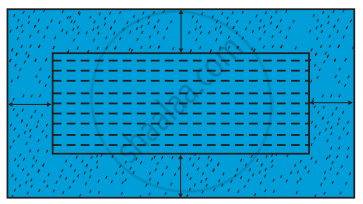
Solve the quadratic equation: x2 – 2ax + (a2 – b2) = 0 for x.
