Advertisements
Advertisements
प्रश्न
Show the formation of NaCl from sodium and chlorine atoms by the transfer of electron(s).
Advertisements
उत्तर
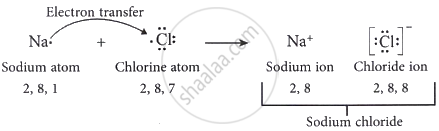
The atomic number of sodium is 11, so its electronic configuration is 2, 8, 1. A sodium atom has only 1 electron in its outermost shell. So, the sodium atom donates 1 electron (to a chlorine atom) and forms a sodium ion, Na+.

Chlorine has an atomic number of 17, resulting in an electronic configuration of 2, 8, 7. The chlorine atom possesses 7 electrons in its valence shell and requires 1 more electron to attain the stable octet configuration characteristic of inert gases. A chlorine atom gains one electron from a sodium atom, forming a negatively charged chloride ion, Cl−.
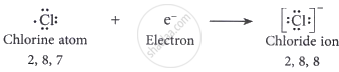
During the reaction between sodium and chlorine, sodium donates its single valence electron to chlorine. By relinquishing one electron, a sodium atom generates a sodium ion (Na+), while by acquiring one electron, a chlorine atom produces a chloride ion (Cl−).