Advertisements
Advertisements
प्रश्न
Show that the point (11, 2) is the centre of the circle passing through the points (1, 2), (3, −4) and (5, −6)
Advertisements
उत्तर
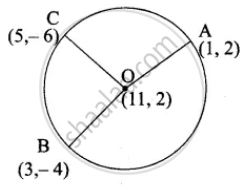
Distance = `sqrt((x_2 - x_1)^2 + (y_2 - y_1)^2`
OA = `sqrt((11 - 1)^2 + (2 - 2)^2`
= `sqrt(10^2 + 0^2)`
= `sqrt(100)`
= 10
OB = `sqrt((11 - 3)^2 + (2 + 4)^2`
= `sqrt(8^2 + 6^2)`
= `sqrt(64 + 36)`
= `sqrt(100)`
= 10
OC = `sqrt((11 - 5)^2 + (2 + 6)^2`
= `sqrt(6^2 + 8^2)`
= `sqrt(36 + 64)`
= `sqrt(100)`
= 10
OA = OB = OC = 10
O is the centre of the circle passing through A, B and C.
APPEARS IN
संबंधित प्रश्न
On a number line, the co-ordinates of P, Q, R are 3, -5 and 6 respectively. State with reason whether the following statement is true or false.
d(R, P) + d(P, Q) = d(R, Q)
Co-ordinates of the pair of points are given below. Hence find the distance between the pair.
- 4, 5
Co-ordinate of point A on a number line is 1. What are the co-ordinates of points on the number line which are at a distance of 7 units from A?
Find the distance between the following pair of points
(3, 4) and (−7, 2)
Determine whether the given set of points are collinear or not
(7, −2), (5, 1), (3, 4)
Show that the following points taken in order to form the vertices of a parallelogram
A(−7, −3), B(5, 10), C(15, 8) and D(3, −5)
Verify that the following points taken in order to form the vertices of a rhombus
A(3, −2), B(7, 6), C(−1, 2) and D(−5, −6)
A(−1, 1), B(1, 3) and C(3, a) are point and if AB = BC, then find ‘a’
The point (x, y) is equidistant from the points (3, 4) and (−5, 6). Find a relation between x and y
Find the distance with the help of the number line given below.

d(K, O)
