Advertisements
Advertisements
प्रश्न
Show that the four points A, B, C, D with position vectors \[\vec{a,} \vec{b,} \vec{c,} \vec{d}\] respectively such that \[3 \vec{a} - 2 \vec{b} + 5 \vec{c} - 6 \vec{d} = 0,\] are coplanar. Also, find the position vector of the point of intersection of the line segments AC and BD.
Advertisements
उत्तर
Let AC and BD intersects at a point P We have,
\[3 \vec{a} - 2 b^\rightharpoonup + 5 c^\rightharpoonup - 6 d^\rightharpoonup = \vec{0} . \]
\[ \Rightarrow 3 \vec{a} + 5 \vec{c} = 2 \vec{b} + 6 \vec{d} \]
Since sum of coefficients on both sides of the above equation is 8 .
so we divide the equation on both sides by 8 .
\[ \Rightarrow \frac{3 \vec{a} + 5 \vec{c}}{8} = \frac{2 \vec{b} + 6 \vec{d}}{8}\]
\[ \Rightarrow \frac{3 \vec{a} + 5 \vec{c}}{3 + 5} = \frac{2 \vec{b} + 6 \vec{d}}{2 + 6}\]
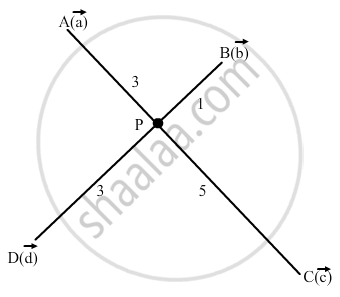
Therefore, P divides AC in the ratio of 3: 5 and P divides BD in the ratio of 2:6.
Therefore, position vector of the point of intersection of AC and BD will be \[\frac{3 \vec{a} + 5 \vec{c}}{8} = \frac{2 \vec{b} + 6 \vec{d}}{8}\]
APPEARS IN
संबंधित प्रश्न
The two vectors `hatj+hatk " and " 3hati-hatj+4hatk` represent the two sides AB and AC, respectively of a ∆ABC. Find the length of the median through A
Let \[\vec{a,} \vec{b,} \vec{c,} \vec{d}\] be the position vectors of the four distinct points A, B, C, D. If \[\vec{b} - \vec{a} = \vec{c} - \vec{d}\], then show that ABCD is a parallelogram.
If \[\vec{a,} \vec{b}\] are the position vectors of A, B respectively, find the position vector of a point C in AB produced such that AC = 3 AB and that a point D in BA produced such that BD = 2BA.
Show that the four points P, Q, R, S with position vectors \[\vec{p}\], \[\vec{q}\], \[\vec{r}\], \[\vec{s}\] respectively such that 5 \[\vec{p}\] − 2 \[\vec{q}\] + 6 \[\vec{r}\] − 9 \[\vec{s}\] \[\vec{0}\], are coplanar. Also, find the position vector of the point of intersection of the line segments PR and QS.
Show that the line segments joining the mid-points of opposite sides of a quadrilateral bisects each other.
Prove by vector method that the internal bisectors of the angles of a triangle are concurrent.
If the position vector of a point (−4, −3) be \[\vec{a,}\] find \[\left| \vec{a} \right|\]
If the position vector \[\vec{a}\] of a point (12, n) is such that \[\left| \vec{a} \right|\] = 13, find the value (s) of n.
If the position vectors of the points A (3, 4), B (5, −6) and C (4, −1) are \[\vec{a,}\] \[\vec{b,}\] \[\vec{c}\] respectively, compute \[\vec{a} + 2 \vec{b} - 3 \vec{c}\].
If \[\vec{a}\] be the position vector whose tip is (5, −3), find the coordinates of a point B such that \[\overrightarrow{AB} =\] \[\vec{a}\], the coordinates of A being (4, −1).
Show that the points 2 \[\hat{i}, - \hat{i}-4 \] \[\hat{j}\] and \[-\hat{i}+4\hat{j}\] form an isosceles triangle.
The position vectors of points A, B and C are \[\lambda \hat{i} +\] 3 \[\hat{j}\],12\[\hat{i} + \mu\] \[\hat{j}\] and 11\[\hat{i} -\] 3 \[\hat{j}\] respectively. If C divides the line segment joining A and B in the ratio 3:1, find the values of \[\lambda\] and \[\mu\]
If \[\overrightarrow{PQ} = 3 \hat{i} + 2 \hat{j} - \hat{k}\] and the coordinates of P are (1, −1, 2), find the coordinates of Q.
Find the position vector of a point R which divides the line segment joining points \[P \left( \hat{i} + 2 \hat{j} + \hat{k} \right) \text{ and Q }\left( - \hat{i} + \hat{j} + \hat{k} \right)\] internally 2:1.
Find the position vector of a point R which divides the line segment joining points:
\[P \left( \hat{i} + 2 \hat{j} + \hat{k}\right) \text { and } Q \left( - \hat{i} + \hat{j} + \hat{k} \right)\] externally
Find the position vector of the mid-point of the vector joining the points P (2, 3, 4) and Q(4, 1, −2).
Show that the points A, B, C with position vectors \[\vec{a} - 2 \vec{b} + 3 \vec{c} , 2 \vec{a} + 3 \vec{b} - 4 \vec{c}\] and \[- 7 \vec{b} + 10 \vec{c}\] are collinear.
Prove that the points having position vectors \[\hat{i} + 2 \hat{j} + 3 \hat{k} , 3 \hat{i} + 4 \hat{j} + 7 \hat{k} , - 3 \hat{i} - 2 \hat{i} - 5 \hat{k}\] are collinear.
If \[\vec{a,} \vec{b}\] are two non-collinear vectors prove that the points with position vectors \[\vec{a} + \vec{b,} \vec{a} - \vec{b}\text{ and }\vec{a} + \lambda \vec{b}\] are collinear for all real values of λ.
Show that the points whose position vectors are as given below are collinear:
\[2 \hat{i} + \hat{j} - \hat{k} , 3 \hat{i} - 2 \hat{j} + \hat{k} \text{ and }\hat{i} + 4 \hat{j} - 3 \hat{k}\]
Show that the four points having position vectors
\[6 \hat{i} - 7 \hat{j} , 16 \hat{i} - 19 \hat{j} - 4 \hat{k} , 3 \hat{j} - 6 \hat{k} , 2 \hat{i} - 5 \hat{j} + 10 \hat{k}\] are coplanar.
Show that the four points A, B, C and D with position vectors \[\vec{a}\], \[\vec{b}\], \[\vec{c}\], \[\vec{d}\] respectively are coplanar if and only if \[3 \vec{a} - 2 \vec{b} + \vec{c} - 2 \vec{d} = \vec{0} .\]
Define position vector of a point.
If \[\vec{a}\], \[\vec{b}\], \[\vec{c}\] are position vectors of the points A, B and C respectively, write the value of \[\overrightarrow{AB} + \overrightarrow{BC} + \overrightarrow{AC} .\]
If D is the mid-point of side BC of a triangle ABC such that \[\overrightarrow{AB} + \overrightarrow{AC} = \lambda \overrightarrow{AD} ,\] write the value of λ.
Find the position vector of a point R which divides the line joining the two points P and Q with position vectors `vec"OP" = 2vec"a" + vec"b"` and `vec"OQ" = vec"a" - 2vec"b"`, respectively, in the ratio 1:2 internally
Find the position vector of a point R which divides the line joining the two points P and Q with position vectors `vec"OP" = 2vec"a" + vec"b"` and `vec"OQ" = vec"a" - 2vec"b"`, respectively, in the ratio 1:2 externally
The position vector of the point which divides the join of points with position vectors `vec"a" + vec"b"` and 2`vec"a" - vec"b"` in the ratio 1:2 is ______.
The position vector of the point which divides the join of points `2vec"a" - 3vec"b"` and `vec"a" + vec"b"` in the ratio 3:1 is ______.
