Advertisements
Advertisements
प्रश्न
Refer to the given figure and select the correct statement.
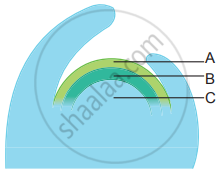
- A, B, and C are histogen of shoot apex
- A Gives rise to medullary rays.
- B Gives rise to cortex
- C Gives rise to epidermis.
विकल्प
i and ii only
ii and iii only
i and iii only
iii and iv only
Advertisements
उत्तर
i and iii only
संबंधित प्रश्न
Where is apical meristem found?
How is meristematic tissue different from permanent tissues?
What is the function of meristematic tissue?
Fill in the blank
......................... tissue is situated at the tip of root and stem.
Which one of the following pairs is correctly matched?
Write one word for the following:
Cells least specialized in plants.
The tissue composed of living thin walled polyhedral cell is ______.
The fibres consists of ______.
Parenchyma, collenchyma, Sclerenchyma are______ type of tissue.
State whether true or false. If false, correct the statement.
Vessels are found in collenchyma.
Girth of stem increases due to
If the tip of sugarcane plant is removed from the field, even then it keeps on growing in length. It is due to the presence of
Which structure protects the plant body against the invasion of parasites?
Define the process of differentiation
______ is derived from the ground meristem.
The meristem found at the base of internodes is called ______.
What are meristems? Describe the distribution and functions of various types of meristems.
How many shoot apical meristems are likely to be present in a twig of a plant possessing, 4 branches and 26 leaves?
Match List - I with List - II.
| List - I | List - II | ||
| (a) | Cells with active cell division capacity |
(i) | Vascular tissues |
| (b) | Tissue having all cells similar in structure and function |
(ii) | Meristematic tissue |
| (c) | Tissue having different types of cells |
(iii) | Sclereids |
| (d) | Dead cells with highly thickened walls and narrow lumen |
(iv) | Simple tissue |
Select the correct answer from the options given below.
