Advertisements
Advertisements
प्रश्न
Prove that at points near the surface of the Earth, the gravitational potential energy of the object is U = mgh.
Advertisements
उत्तर
When an object of mass m is raised to a height h, the potential energy stored in the object is mgh. This can be derived using the general expression for gravitational potential energy.
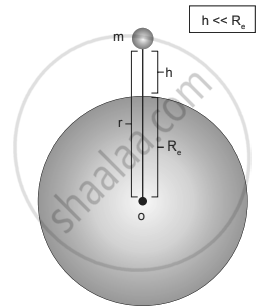
Mass placed at a distance r from the center of the Earth
Consider the Earth and mass system, with r, the distance between the mass m and the Earth’s center. Then the gravitational potential energy.
U = `-("GM"_"e""m")/"r"` ....(1)
Here r = Re + h, where Re is the radius of the Earth, h is the height above the Earth’s surface
U = `-"G"("M"_"e""m")/("R"_"e" + "h")` ....(2)
If h << Re , equation (2) can be modified as
U = `-"G"("M"_"e""m")/("R"_"e"(1 + "h"/"R"_"e"))`
U = `-"G"("M"_"e""m")/("R"_"e")(1 + "h"/"R"_"e")^-1` ...........(3)
By using Binomial expansion and neglecting the higher order terms, we get
`(1 + "x")^"n" = 1 + "nx" + ("n"("n" - 1))/(2!) "x"^2 + ... + ∞`
Here, x = `"h"/"R"_"e"` and n = − 1
`(1 + "h"/"R"_"e")^-1 = (1 - "h"/"R"_"e")`
Replace this value and we get,
U = `-("GM"_"e""m")/"R"_"e" (1 - "h"/"R"_"e")` .....(4)
We know that, for a mass m on the Earth’s surface,
`"G"("M"_"e""m")/"R"_"e" = "mgR"_"e"` .....(5)
Substituting equation (4) and (5) we get,
U = −mge + mgh ……..(6)
It is clear that the first term in the above expression is independent of the height h. For example, if the object is taken from height h1 to h2, then the potential energy at h1 is
U(h1) = – mgRe + mgh1 …(7)
and the potential energy at h2 is
U(h2) = – mgRe + mgh2 …(8)
The potential energy difference between h1 and h2 is
U(h2) – U(h1) = mg(h2 – h1) …(9)
The term mgRe in equations (7) and (8) plays no role in the result.
Hence in equation (6) the first term can be omitted or taken to zero.
Thus it can be stated that the gravitational potential energy stored in the particle of mass m at a height h from the surface of the Earth is U = mgh.
On the surface of the Earth, U = 0, since h is zero.
APPEARS IN
संबंधित प्रश्न
An object of mass 10 kg is hanging on a spring scale which is attached to the roof of a lift. If the lift is in free fall, the reading in the spring scale is ___________.
Will the angular momentum of a planet be conserved? Justify your answer.
Define gravitational potential.
Derive the expression for gravitational potential energy.
The work done by Sun on Earth in one year will be
The work done by Sun on Earth at any finite interval of time is
If the Earth’s pull on the Moon suddenly disappears, what will happen to the Moon?
Two bodies of masses m and 4m are placed at a distance of r. Calculate the gravitational potential at a point on the line joining them where the gravitational field is zero.
If the ratio of the orbital distance of two planets `"d"_1/"d"_2` = 2, what is the ratio of gravitational field experienced by these two planets?
An object is thrown from Earth in such a way that it reaches a point at infinity with non-zero kinetic energy `["K"."E"("r" = ∞) = 1/2 "Mv"_"∞"^2]`, with what velocity should the object be thrown from Earth?
