Advertisements
Advertisements
प्रश्न
Processing of food required grinding equipment as well as vessels for mixing, blending and cooking. These were made of stone, metal and terracotta. This is an excerpt from one of the earliest reports on excavations at Mohenjodaro, the best-known Harappan site:
Saddle querns … are found in considerable numbers … and they seem to have been the only means in use for grinding cereals. As a rule, they were roughly made of hard, gritty, igneous rock or sandstone and mostly show signs of hard usage. As their bases are usually convex, they must have been set in the earth or in mud to prevent their rocking. Two main types have been found: those on which another smaller stone was pushed or rolled to and fro, and others with which a second stone was used as a pounder, eventually making a large cavity in the nether stone. Querns of the former type were probably used solely for grain; the second type possibly only for pounding herbs and spices for making curries. In fact, stones of this latter type are dubbed “curry stones” by our workmen, and our cook asked for the loan of one from the museum for use in the kitchen.
FROM ERNEST MACKAY, Further Excavations at Mohenjodaro, 1937.
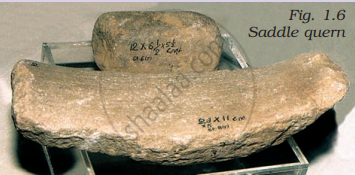
Archaeologists use present-day analogies to try and understand what ancient artefacts were used for. Mackay was comparing present-day querns with what he found. Is this a useful strategy?
Advertisements
उत्तर
Yes, comparing ancient artefacts to modern-day objects is a very useful strategy. This method is known as using an “ethno-archaeological analogy.”
It helps archaeologists understand the past in three major ways:
- Understanding Daily Life: Everyday household tools like kitchen grinding stones (saddle querns), storage pots, and jewellery beads have fundamentally remained the same for thousands of years.
- Identifying Function: By looking at how a modern kitchen uses a sil-batta (grinding stone), archaeologist Ernest Mackay could easily deduce that the large ancient stones were used for grinding grains, while the smaller pounding stones were used for crushing herbs and spices.
- Bridges the Gap: Since ancient people cannot speak to us, looking at surviving traditional practices is often the only realistic way to understand ancient technology.
However, archaeologists must use this strategy carefully. A tool that looks like a modern object today might have had a completely different or even sacred ritual meaning in the past.
