Advertisements
Advertisements
प्रश्न
On an outline map of the world, show the world distribution of earthquakes. Mark earthquake-prone areas in India. Identify the reasons for earthquakes in each region.
नक्शा
विस्तार में उत्तर
Advertisements
उत्तर
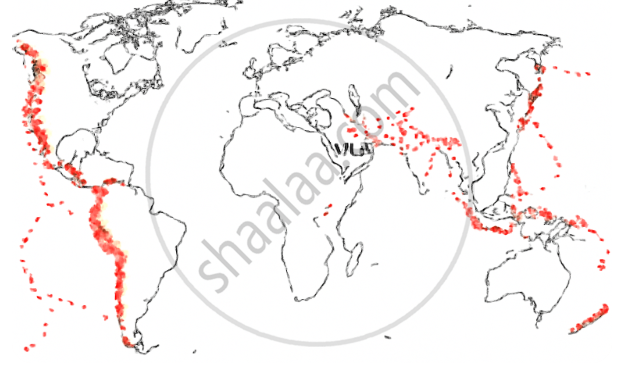
- The Ring of Fire (Pacific Ocean Region)
- Cause: Most earthquakes in this region occur due to the movement of tectonic plates along subduction zones, where one plate is forced beneath another. The Pacific Plate is subducting beneath several surrounding plates, including the Eurasian, Philippine, and Nazca plates.
- Reason for Earthquakes: The compression and tension at plate boundaries cause stress to build up over time. When this stress is released, it results in powerful earthquakes.
- Himalayan Region (Asia)
- Cause: The Indian Plate is colliding with the Eurasian Plate at a convergent boundary, causing the crust to buckle, forming mountains and triggering earthquakes.
- Reason for Earthquakes: The continuous collision and tectonic compression in this region produce intense seismic activity, particularly in regions like Nepal, India, and Tibet. The convergence of these plates leads to the formation of the Himalayas and causes frequent earthquakes, including major ones like the 2015 Nepal earthquake.
- Alpide Belt (Europe to Asia)
- Cause: The African Plate and the Eurasian Plate are converging, and this results in tectonic stresses in the Alpide or Mediterranean-Himalayan Belt.
- Reason for Earthquakes: These earthquakes are primarily caused by the convergence and collision of these plates. This stress leads to the formation of mountain ranges like the Alps, and regular seismic activity is a result of these plate movements.
- San Andreas Fault Zone (California, USA)
- Cause: The Pacific Plate is sliding past the North American Plate at a transform boundary along the San Andreas Fault.
- Reason for Earthquakes: The lateral sliding of these plates causes friction along the fault. Over time, pressure builds up until it’s released as an earthquake. This fault zone is responsible for significant earthquakes in California.
- Mid-Atlantic Ridge (Atlantic Ocean)
- Cause: The North American Plate and the Eurasian Plate are moving apart at a divergent boundary, creating new oceanic crust along the Mid-Atlantic Ridge.
- Reason for Earthquakes: The divergence of plates causes tension, resulting in earthquakes and the formation of new oceanic crust. As the plates separate, seismic activity occurs, albeit generally less intense than in other regions.
- Indian Ocean Region
- Cause: The Indian Plate is colliding with the Australian Plate and Eurasian Plate, causing subduction and continental collision in regions like Sumatra and Indonesia.
- Reason for Earthquakes: Tectonic movements such as subduction (one plate diving beneath another) in this area cause massive earthquakes, especially in the Java Trench and surrounding regions.
- Other Earthquake-Prone Areas in India
- Cause: India, especially the Himalayan region, is part of the Alpide-Himalayan seismic belt, which is highly vulnerable to earthquakes due to the collision of the Indian Plate with the Eurasian Plate. Areas in Assam, Jammu and Kashmir, and Gujarat experience frequent seismic activity due to such tectonic movements.
- Reason for Earthquakes: The continuous plate collision and subduction zones cause stress within the crust, leading to periodic release in the form of earthquakes.
Most of the world’s earthquakes are caused by the movement of tectonic plates, which may involve collision, subduction, sliding, or separation of plates. These movements result in the release of energy as seismic waves, causing earthquakes.
shaalaa.com
क्या इस प्रश्न या उत्तर में कोई त्रुटि है?
