Advertisements
Advertisements
प्रश्न
Obtain an expression for the orbital magnetic moment of an electron rotating about the nucleus in an atom.
Advertisements
उत्तर १
In the Bohr model of a hydrogen atom, the electron of charge −e performs a uniform circular motion around the positively charged nucleus. Let r, v and T be the orbital radius, speed and period of motion of the electron. Then,
T = `(2pir)/v` ...(i)
Therefore, the orbital magnetic moment associated with this orbital current loop has a magnitude,
I = `e/T = (ev)/(2pir)` ...(ii)
Therefore, the magnetic dipole moment associated with this electronic current loop has a magnitude,
MO = Current × Area of the loop
= `I(pir^2)`
= `(ev)/(2pir) xx pir^2`
= `1/2 evr` ...(iii)
Multiplying and dividing the right-hand side of the above expression by the electron mass me,
`M_O = e/(2m_e) (m_evr)`
= `e/(2m_e) L_O` ...(iv)
where LO = mevr is the magnitude of the orbital angular momentum of the electron. `vecM_O` is opposite to `vecL_O`.
∴ `vecM_O = - e/(2m_e) vecL_O` ...(v)
which is the required expression.
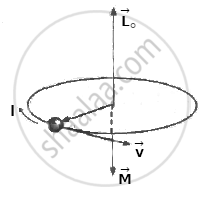
According to Bohr’s second postulate of stationary orbits in his theory of the hydrogen atom, the angular momentum of the electron in the nth stationary orbit is equal to n `h/(2pi)`, where h is the Planck constant and n is a positive integer. Thus, for an orbital electron,
`L_O = m_e vr = (nh)/(2pi)` ...(vi)
Substituting for LO in Eq. (iv),
`M_O = (enh)/(4pim_e)`
For n = 1, MO = `(eh)/(4pim_e)`
The quantity `(eh)/(4pim_e)` is a fundamental constant called the Bohr magneton,
∴ μB ⋅ μB
= 9.274 × 10⁻²⁴ J/T (or Am2)
= 5.788 × 10⁻⁵ eV/T
उत्तर २
Consider an electron of mass me and charge e revolving in a circular orbit of radius r around the positive nucleus in a clockwise direction, leading to an anticlockwise current.
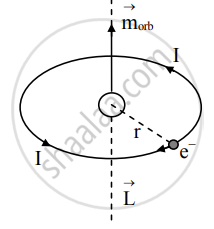
U.C.M of an electron around the nucleus
If the electron travels a distance 2πr in time T, then its orbital speed v = `(2πr)/T`
The magnitude of circulating current is given by,
I = `e(1/T)`
But, T = `(2pir)/v`
∴ I = `e(1/((2pir)/v)) = (ev)/(2pir)`
The orbital magnetic moment associated with the orbital current loop is given by,
morb = IA = `(ev)/(2pir) xx pir^2` ...[∵ Area of current loop, A = πr2]
∴ morb = `(evr)/2` ….(1)
The angular momentum of an electron due to its orbital motion is given by,
L = mevr
Multiplying and dividing the R.H.S of equation (1) by me,
`m_"orb" = e/(2m_e) xx m_evr`
∴ `m_"orb" = (eL)/(2m_e)`
This equation shows that the orbital magnetic moment is proportional to the angular momentum. But as the electron bears a negative charge, the orbital magnetic moment and orbital angular momentum are in opposite directions and perpendicular to the plane of the orbit.
Using vector notation, `vecm_"orb" = (e/(2m_e))vecL`
उत्तर ३
Consider an electron moving with constant speed v in a circular orbit of radius r about the nucleus as shown in the figure.

If the electron travels a distance of 2πr (circumference) in time T, then its orbital speed, `v = (2pir)/T`.
Thus the current I associated with this orbiting electron of charge e is
`I = e/T`
`T = (2pi)/ω and ω = v/r`, the angular speed
`I = (eω)/(2pi) = (ev)/(2pir)`
The orbital magnetic moment associated with orbital current loop is
`m_("orb") = IA = (ev)/(2pir) xx pir^2`
= `1/2evr`
APPEARS IN
संबंधित प्रश्न
What is stated in terms of Bohr magneton?
The electron in the hydrogen atom is moving with a speed of 2.5 × 10⁶ m/s in an orbit of a radius of 0.5 Å. What is the Magnetic moment of the revolving electron?
If M0 and L0 denote the orbital angular moment and the angular momentum of the electron due to its orbital motion, then the gyromagnetic ratio is given by ______
A circular coil of radius R has a resistance of 40 Ω. Figure shows two points P and Q on the circumference separated by a distance `(pi"R")/2`, which are connected to a 16 V battery with internal resistance of 0.5 Ω. What is the value of current I flowing through the circuit?

The magnetic moment of electrons due to orbital motion is proportional to ______.
(n = principal quantum numbers)
The S.I. unit of gyromagnetic ratio is ______
The Gyromagnetic ratio of the electron revolving in a circular orbit of a hydrogen atom is 8.8 x 10¹⁰ C kg-1. What is the mass of the electron? (Given charge of the electron = 1.6 x 10⁻¹⁹ C.)
The angle made by orbital angular momentum of electron with the direction of the orbital magnetic moment is ______.
Dimensions of Gyromagnetic ratio are _________.
An electron revolving in a circular orbit of radius 'r' with velocity 'v' and frequency v has orbital magnetic moment 'M'. If the frequency of revolution is tripled then the new magnetic moment will be ____________.
The electron in the hydrogen atom is moving with a speed of 1.5 x 10⁶ m/s in an orbit of radius 2 Å. Magnetic moment of the revolving electron is ____________.
Which one of the following proportionality represents the relation between orbital magnetic moment M0 and orbital angular momentum L0 of an electron?
An electron (e) is revolving in a circular orbit of radius 'r' in hydrogen atom. The angular momentum of the electron is (M = magnetic dipole moment associated with it and m = mass of electron) ____________.
Magnetic moment of revolving electron of charge 'e' and mass 'm' in terms of angular momentum 'L' of electron is ____________.
An electron in the ground state of hydrogen atom is revolving in a circular orbit of radius R. The orbital magnetic moment of the electron is ____________. (m = mass of electron, h = Planck's constant, e = electronic charge)
In an atom, electron of charge (-e) perform U.C.M. around a stationary positively charged nucleus, with period of revolution 'T'. If 'r' is the radius of the orbit of the electron and 'v' is the orbital velocity, then the circulating current (I) is proportional to ____________.
Which of the following expression represents the relation between orbital magnetic moment and orbital angular momentum of an electron?
A bar magnet of magnetic moment M1 is cut into two pieces along its axis. The pieces are kept perpendicular to each other with their unlike poles in contact. The magnetic moment of the arrangement is M2. The ratio of M1/M2 is ______.
An electron in an atom is revolving around the nucleus in a circular orbit of radius 0.53 A, with a speed of 2 x 10⁶ m/s. Find the resultant orbital magnetic moment and angular momentum of electron.(e = 1.6 x 10⁻¹⁹ C, m = 9.1 x 10⁻³¹ kg)
The electron in the hydrogen atom is moving with a speed at 2.3 x 10⁶ m/s in an orbit of radius 0.53Å. Calculate the magnetic moment of the revolving electron.
An electron of charge ‘e’ and mass ‘m’ is revolving which has orbital magnetic moment ‘M’. Its angular momentum is given by ______.
