Advertisements
Advertisements
प्रश्न
Observe the picture and answer the following questions.
A) Which evidence of evolution is shown in the picture?
B) What can be proven with this proof?
C) Give one more example of evidence of evolution
Advertisements
उत्तर
A) Embryological evidence of evolution has been shown in the picture.
B) Similarities between all embryos in early stages indicates that all those animals may have common ancestor.
C) Vestigial organs, Connecting link, etc.
APPEARS IN
संबंधित प्रश्न
State the connecting links between Peripatus with Annelida and Arthopoda.
Select two pairs from the following which exhibit divergent evolution. Give reasons for your answer.
(i) Forelimbs of cheetah and mammals
(ii) Flippers of dolphins and penguins
(iii) Wings of butterflies and birds
(iv) Forelimbs of whales and mammals
Differentiate between analogy and homology giving one example each of plant and animal respectively.
How do homologous organs help in providing evidence for organic evolution?
Human tailbone is a vestigial organ. Explain.
X, Y, and Z are three animals. The animal X can fly but animal Y can only run on ground or walls. The forelimbs of animals X and Y have the same basic design but they are used for different purposes such as flying and running respectively. The animal Z became extinct an long time ago. The study of fossils of Z tells us that it had some features like those of X and some like those of Y. In fact, Z is said to form a connecting link in the evolutionary chain of X and Y.
(a) What could the animals X, Y and Z be?
(b) What name is given to the forelimbs like those of X and Y which have the same basic design but different functions?
(c) Name one feature in which Z resembled X.
(d) Name one feature in which Z resembled Y.
(e) Which is the correct evolutionary chain involving X, Y and Z : X → Z → Y or Y → Z → X?
Select a set of homologous organs from the following:
(A) Wings of a bat and wings of a butterfly
(B) Wings of a pigeon and wings of a bat
(C) Wings of a butterfly and wings of a pigeon
(D) Forelimbs of a duck, forelimbs of a cow and forelimbs of a lizard
Complete the following chart:
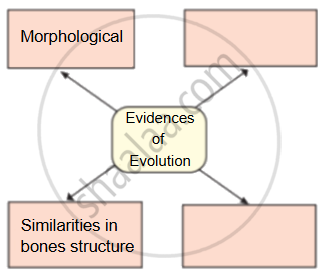
Draw a labelled diagram of T.S. of a leaf showing Kranz anatomy.
Explain the importance of Anatomical evidences with examples.
Write a short note:
Embryological evidences
Homologous organs and vestigial organs are examples of ______ type of evidence in evolution.
Select the CORRECT set of homologous organs.
Where is carbon dating used?
Palaeontological evidence for evolution refers to the ______.
What are we referring to? When we say 'simple organisms' or 'complex organisms'.
Give an example for convergent evolution and identify the features towards which they are converging.
The evolutionary story of moths in England during industrialisation reveals, that 'evolution is apparently reversible'. Clarify this statement.
You have studied the story of Peppermoths in England. Had the industries been removed, what impact could it have had on the moth population? Discuss.
I am the connecting link of annelida and arthropoda. What is my name?
