Advertisements
Advertisements
प्रश्न
Note the relationship between the first two words and suggest the suitable word/words for the fourth place.
Ears: Auditory nerve :: Eyes : ______.
Advertisements
उत्तर
Ears : Auditory nerve :: Eyes : Optic nerve.
APPEARS IN
संबंधित प्रश्न
Draw labelled diagrams of the following: Ear
Deafness is causal due to the rupturing of the Pinna.
- Draw a well-labelled diagram of the membranous labyrinth found in the inner ear.
- Based on the diagram drawn above in (i), give a suitable term for each of the following descriptions:
- The sensory cells that help in hearing.
- The part that is responsible for static balance of the body.
- The membrane-covered opening that connects the middle ear to the inner ear.
- The fluid present in the middle chamber of cochlea.
- The structure that maintains dynamic equilibrium of the body.
State the main function of the Suspensory ligament of the eye
Where is the Cochlea located? Briefly mention its function.
With reference to the human ear, answer the question that follow:
Name the nerve, which transmits messages from the ear to the brain.
Given below is a diagram of a part of the human ear. Study the same and answer the question that follow:
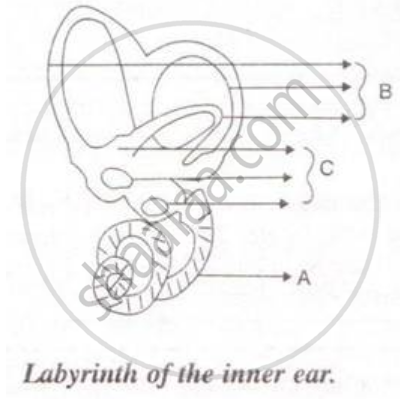
Name the parts labeled A, B and C in the diagram.
Given below is a diagram of a part of the human ear. Study the same and answer the question that follow:

Name the audio receptor region present in the part labeled 'A'.
The part of the inner ear which is responsible for hearing is ______.
Note the relationship between the first two words and suggest the suitable word/words for the fourth place.
Semi-circular canal : Ampulla :: Cochlea : ______.
