-
Open Circulatory System – Blood flows freely through open spaces or sinuses, rather than being confined to vessels. Example: Arthropods (insects) and mollusks.
-
Closed Circulatory System – Blood remains within a network of vessels (arteries, veins, and capillaries) throughout the body. Example: Vertebrates (humans, fish, amphibians) and annelids (earthworms).
Advertisements
Advertisements
प्रश्न
Name these:
Two kinds of circulatory systems in different animals.
अति संक्षिप्त उत्तर
Advertisements
उत्तर
The two kinds of circulatory systems in different animals are:
shaalaa.com
क्या इस प्रश्न या उत्तर में कोई त्रुटि है?
अध्याय 8: The Circulatory System - Review Questions [पृष्ठ ११६]
APPEARS IN
संबंधित प्रश्न
Note the relationship between the first two words and suggest a suitable word/words for the fourth place:
Coronary artery : Heart :: Hepatic artery : ______
what is Venule?
How do you account for the following difference?
The left ventricle has thicker walls than the right ventricle.
Give reason for the following:
The blood groups of both the donor and recipient must be known before transfusing blood.
Given below is a highly schematic diagram of the human blood circulatory system.
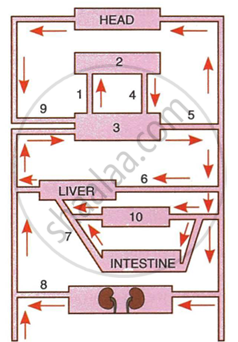 |
- Which part (state the number) represents the heart? Give reason in support of your answer.
- Which numbers represent the following, respectively?
Aorta Superior vena cava Hepatic portal vein Renal Vein Pulmonary artery Stomach
Describe the functions of the: Blood vessels
Use your brain power!
How is the air that we inhale purified in our body?
Which of the following cells are produced from reticulocytes?
Serum differs from blood in lacking ____________.
Identify the CORRECT statement/s regarding blood clotting.
