Advertisements
Advertisements
प्रश्न
Name the three social classes of ancient Egypt. Mention the people who constituted each of these classes.
Advertisements
उत्तर
The Egyptians were divided into three distinct classes. These are following
- The upper class— The upper class consisted of the royal family, rich landowners, high ranking priests, government officials, and doctors
- The middle class— The middle class consisted of merchants, manufactures, craftspersons and the lower clergy.
- The lower class— This class consisted of the peasants, At the bottom of the social hierarchy were the slaves who were mainly prisoners of war.
APPEARS IN
संबंधित प्रश्न
Choose the correct answer:
The _____ tree was probably regarded as sacred by the Harappans.
Choose the correct answer:
The Harappan civilization belongs to the _______
Answer the following question briefly:
Describe the contribution of the Chinese civilisation in various fields.
Answer the following question briefly:
Describe the religion of the people of the Chinese civilisation.
Text Book Keyword
Shang dynasty
Text Book Keyword
Oracles
Text Book Keyword
Great Wall of China
Fill in the blanks.
esopotamia is called the ___________ and __________civilization.
Fill in the blank.
Men and women wore dresses made of _______.
Write a short note on the following:
Egyptian Solar Calendar
Discuss briefly the contributions of the ancient Egyptian in the following field:
Medicine
Fill in the blanks.
The Chinese wrote on ___or _________ and later on ______.
Fill in the blanks.
In the 1st century CE, the Chinese made paper from the _______________ and ___________.
Give a brief account of the following:
Sericulture
State whether the following statement is true or false.
The emperor occupied the highest position in Chinese society.
Fill in the blanks.
Mesopotamia is called the __________ and _________ of many civilizations.
State whether the following statement is true or false.
Mesopotamia is called the cradle and grave of many civilizations.
Answer the following question briefly:
What were the main features of town planning in Mesopotamia?
This is the picture of a building in the Mesopotamian city of ur.
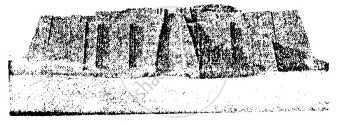
- Identify the building.
- What is the significance of the building?
- What do you know about the architectural contributions of the Mesopotamians?
State whether the following statement is true or false:
The first known dynasty of China was the Qin dynasty.
