Advertisements
Advertisements
प्रश्न
Name the three ear ossicles.
Advertisements
उत्तर
The three ear ossicles are Malleus (hammer), Incus (anvil), and Stapes (stirrup).
APPEARS IN
संबंधित प्रश्न
Write short notes on the following Ear ossicles
Briefly explain the following terms: Power of accommodation
With reference to the human ear, answer the question that follow:
Name the part of the ear associated with
(1) static balance
(2) hearing
(3) dynamic balance.
Mention the exact location of the following :
Incus
The figure below is the sectional view of a part of the skull showing a sense organ:
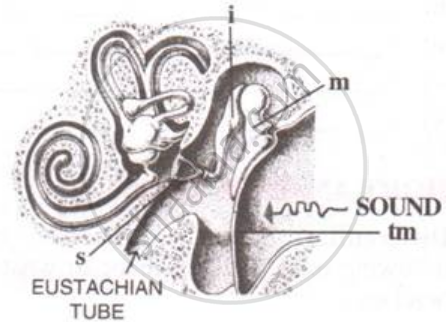
What are the parts labeled 'm', 'i' and 's'? What do these parts constitute collectively?
Differentiate between:
The middle ear and Inner ear.
Given below is the diagram of the human ear. Study the diagram and then answer the questions that follow:

(i) What role does the eardrum play in hearing?
(ii) What common term is given to the parts labeled A, B, and E?
(iii) Would there be any difference if these three parts mentioned in (ii) above were replaced by one by one? Why?
(iv) Give the biological term for the parts labeled C and D.
(v) Name the fluid which fills the parts mentioned in (iv) above.
(vi) State the functions of the ear.
Complete the following sentence with appropriate Word
The sequence of ear ossicles of vertebrates starting from the tympanum is:
The part of the ear that turns pressure variations into electrical signals is ______.
The Eardrum moves inward when a rarefaction reaches it.
