Advertisements
Advertisements
प्रश्न
Advertisements
उत्तर
The physical quantity is ‘torque’.
Torque may be defined as the turning effect produced by a force on a rigid body about a point, pivot, or fulcrum. It is measured by the product of force and the perpendicular distance of the pivot from the line of action of force.
APPEARS IN
संबंधित प्रश्न
A half metre rod is pivoted at the centre with two weights of 20gf and 12gf suspended at a perpendicular distance of 6 cm and 10 cm from the pivot respectively as shown below.
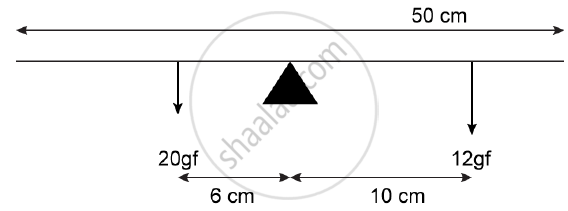
1) Which of the two forces acting on the rigid rod causes clockwise moment?
2) Is the rod in equilibrium?
3) The direction of 20 kgf force is reversed. What is the magnitude of the resultant moment of the forces on the rod?
Find the moment of force of 20 N about an axis of rotation at distance 0.5 m from the force.
State Newton's Second law of motion. Under what conditon does it take the form F = ma?
State Newton's third law of motion.
A nut is opened by a wrench of length 10 cm. if the least force required is 5.0 N. find the moment of force needed to turn the nut.
Give an example of the following uses of a machine:
to change the direction of force
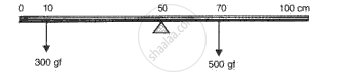
Fig. 5 shows a uniform meter scale weighing 200 gf. Provided at its centre. Two weights 300 gf and 500 gf are suspended from the ruler as shown in the diagram. Calculate the resultant torque of the ruler and hence calculate the distance from mid-point where a 100 gf should be suspended to balance the meter scale.
Write the expression for the moment of force about a given axis.
State the units of moment of force.
A uniform metre rule rests horizontally on a knife-edge at the 60 cm mark when a mass of 10 gram is suspended from one end. At which end must this mass be suspended? What is the mass of the rule?
