Advertisements
Advertisements
प्रश्न
Name and describe very briefly, the stages in the development of human embryo.
Advertisements
उत्तर
- Fertilisation:
- The fertilised egg divides into a solid mass of cells called the Morula.
- Morula to Blastocyst:
- The Morula transforms into a fluid-filled structure called the blastocyst.
- The blastocyst's outer layer, known as the trophoblast, has a nutritional purpose.
- Implantation:
- The blastocyst, now a fluid-filled embryo, enters the uterus approximately 4-6 days after fertilisation.
- The trophoblast digests and embeds into the uterine endometrium, a process called implantation.
- Implantation initiates pregnancy and delivers oxygen and nutrients to the developing fetus.
- Early embryonic development:
- During the first three weeks, the embryo is roughly the size of a large pea.
- By the 5th week, the embryo has developed the heart and blood vessels but lacks limbs.
- Formation of the Foetus:
- During the 8th week of pregnancy, the foetus develops limbs similar to those of humans.
- Role of the Placenta and Umbilical Cord:
- The placenta supplies materials through diffusion.
- The umbilical cord connects the placenta to the foetus.
- Embryonic Membranes:
- The embryo is surrounded by three membranes: the amnion (which contains amniotic fluid), the chorion, and the allantois.
- Gestation Period:
- The gestation period lasts around 280 days, from implantation to birth.
- Childbirth:
- The baby is usually delivered head first due to strong uterine muscular contractions.
- The umbilical cord is cut, and the placenta is ejected after birth.
APPEARS IN
संबंधित प्रश्न
State whether the following statements are TRUE (T) or FALSE (F):
Rewrite the wrong statement by correcting only one word either at the beginning or at the end of the sentence.
Uterus is also known as birth canal.
Describe the functions of Amnion
Describe briefly the ways how a mammalian embryo is nourished
Differentiate
Uterus and Urethra.
Study the diagram given below and then answer the questions that follow:
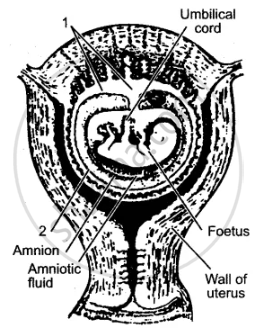
(i) Name the parts labeled 1 and 2. State the function of each part.
(ii) State any one function of the amniotic fluid.
(iii) What is the role of the umbilical cord in the development of the fetus?
(iv) Name the part in the diagram which is endocrine in nature.
Complete the following sentences with appropriate word:
The period of complete development of the fetus until birth is termed ______.
Write the functional activity of the following structure:
Uterus
Which of the following hormones is produced by ovary?
List the substances which the foetus receives from the mother through placenta.
Given below is the name of certain stage/substance related to reproduction and found in human body. Answer the questions related to it.
Morula.
- What is this stage?
- Name the stage which comes next to it?
