Advertisements
Advertisements
प्रश्न
Name a waste gas released by the plants only during the daytime.
Advertisements
उत्तर
Oxygen is released only during the daytime. This is because oxygen is produced by photosynthesis only in the presence of sunlight.
APPEARS IN
संबंधित प्रश्न
Mention the exact location of the Prostate gland.
The form in which glucose in stored in liver.
Write the functions of Ureter.
Correct the following statements by changing the underlined words:
The normal pale yellow colour of the urine is due to the presence of the pigment Melanin.
Fill in the following blank with suitable word:
Gums and resins are the .......... products of plants.
Define excretion. Name the excretory unit of a kidney.
Put a tick mark (✓) against the most appropriate alternative in the following statement :
In human beings, urea is produced in :
Fill in the blank.
.................. produces bile pigments from the heamoglobin of broken RBCs.
Define the following term:
Osmoregulation
Choose the odd one out in the following serie:
Column of Bertini, minora calyces, brain.
Label the diagram given below :

Look at the figure given below. It is a section of human kidney as seen from the front.
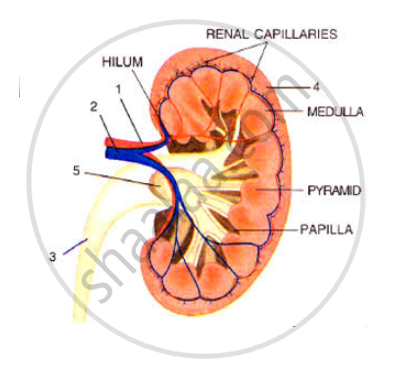
Which area/part (give its name and number given on the diagram) which contains the following:
(i) Malpighian capsule
(ii) The pyramids
(iii) Freshly collected urine
Explain the Term: Glomerulus
Name the Following
The term used for Bowman’s capsule and glomerulus together.
Complete the following sentence with appropriate word:
______ is the functional unit of kidney.
Choose the correct option.
Which one of the following organisms would spend maximum energy in the production of nitrogenous waste?
Choose the correct option.
Visceral layer : Podocytes :: PCT : ________.
Answer the following question.
Birds are uricotelic in nature. Give reason.
Give two examples of the following:
Bile pigments
