Advertisements
Advertisements
प्रश्न
Mention the two features of x-ray spectra, not explained by classical electromagnetic theory.
Advertisements
उत्तर
Though classical electromagnetic theory suggests the emission of radiations from accelerating electrons, it could not explain two features exhibited by x-ray spectra. These features are given below
- For a given accelerating voltage, the lower limit for the wavelength of continuous x-ray spectra is the same for all targets. This minimum wavelength is called cut-off wavelength.
- The intensity of x-rays is significantly increased at certain well-defined wavelengths as shown in the case of characteristic x-ray spectra for molybdenum.
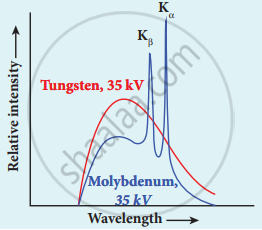
APPEARS IN
संबंधित प्रश्न
If the mean wavelength of light from sun is taken as 550 nm and its mean power as 3.8 × 1026 W, then the average number of photons received by the human eye per second from sunlight is of the order of
The work functions for metals A, B and C are 1.92 eV, 2.0 eV and 5.0 eV respectively. The metal/metals which will emit photoelectrons for a radiation of wavelength 4100Å is/are
How does photocurrent vary with the intensity of the incident light?
Mention the different types of photocells.
List out the laws of photoelectric effect.
Explain the quantum concept of light.
List out the characteristics of photons.
Calculate the energies of the photons associated with the following radiation:
- violet light of 413 nm
- X-rays of 0.1 nm
- radio waves of 10 m
When a light of frequency 9 × 10¹⁴ Hz is incident on a metal surface, photoelectrons are emitted with a maximum speed of 8 × 10⁵ ms−1. Determine the threshold frequency of the surface.
At the given point of time, the earth receives energy from the sun at 4 cal cm–2 min–1. Determine the number of photons received on the surface of the Earth per cm2 per minute. (Given: Mean wavelength of sunlight = 5500 Å)
