Advertisements
Advertisements
प्रश्न
Maximize Z = 60x + 50y Subject to x + 2y ≤ 40, 3x + 2y ≤ 60, x ≥ 0, y ≥ 0
आलेख
योग
Advertisements
उत्तर
| Inequation | Equation | Double intercept form | Points (x, y) | Region |
| x + 2y ≤ 40 | x + 2y = 40 | `x/(40) + y/(20)` = 1 | A (40, 0) B (0, 20) |
0 + 2(0) ≤ 40 ∴ 0 ≤ 40 ∴ origin-side |
| 3x + 2y ≤ 60 | 3x + 2y = 60 | `x/(20) + y/(30)` = 1 | C (20, 0) D (0, 30) |
3(0) + 2(0) ≤ 60 ∴ 0 ≤ 60 ∴ origin-side |
| x ≥ 0 | x = 0 | – | – | R.H.S. of Y-axis |
| y ≥ 0 | y = 0 | – | – | Above X-axis |
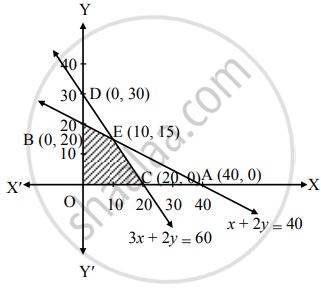
Shaded portion OBEC is the feasible region
Whose vertices are O (0, 0), B(0, 20), E and C (20, 0)
E is the point of intersection of lines
x + 2y = 40 …(i)
3x + 2y = 60 …(ii)
∴ By (i) – (ii), we get
x + 2y = 40
3x + 2y = 60
– – –
–2x = –20
∴ x = `(-20)/(-2)`
∴ x = 10
Substituting x = 10 in (i), we get
10 + 2y = 40
∴ 2y = 40 – 10
∴ 2y = 30
∴ y = `(30)/(2)` = 15
∴ E = (10, 15)
Here, the objective function is Z = 60x + 50y
Now, we will find maximum value of Z as follows:
| Feasible points | The value of Z = 60x + 50y |
| O (0, 0) | Z = 60(0) + 50(0) = 0 |
| B (0, 20) | Z = 60(0) + 50(20) = 1000 |
| E (10, 15) | Z = 60(10) + 50(15) = 600 + 750 = 1350 |
| C (20, 0) | Z = 60(20) + 50(0) = 1200 |
∴ Z has maximum value 1350 at E (10, 15)
∴ Z is maximum, when x = 10, y = 15.
shaalaa.com
क्या इस प्रश्न या उत्तर में कोई त्रुटि है?
