Advertisements
Advertisements
प्रश्न
Match the terms of column I with those of column II:
| Column I | Column II | ||
| (a) | Adenohypophysis | (i) | Thyroxine |
| (b) | Neurohypophysis | (ii) | TSH |
| (c) | Thyroid | (iii) | Oxytocin |
| (d) | Adrenaline | (iv) | Insulin |
| (e) | Islets of Langerhans | (v) | Epinephrine |
| (f) | Hypothalamus | (vi) | Growth hormone |
| (g) | Pituitary gland | (vii) | Pituitary gland |
Advertisements
उत्तर
| Column I | Column II | ||
| (a) | Adenohypophysis | (vi) | Growth hormone |
| (b) | Neurohypophysis | (iii) | Oxytocin |
| (c) | Thyroid | (i) | Thyroxine |
| (d) | Adrenaline | (v) | Epinephrine |
| (e) | Islets of Langerhans | (iv) | Insulin |
| (f) | Hypothalamus | (vii) | Pituitary gland |
| (g) | Pituitary gland | (ii) | TSH |
APPEARS IN
संबंधित प्रश्न
The diagram given below represents an endocrine gland in the human body. Study the diagram and answer the following questions:
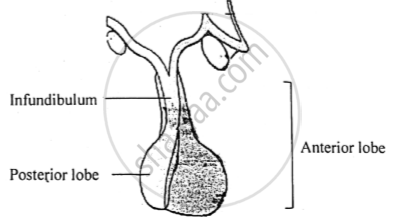
- Identify the endocrine gland. Where is it located?
- Why is the above gland referred to as the ‘Master gland’?
- Name the hormone which in deficiency causes Diabetes Insipidus. How does this disorder differ from Diabetes Mellitus?
- Explain the term ‘Hormone’. What is the role of Tropic hormones in the human body?
- Which lobe of the above gland secretes:
- Oxytocin
- ACTH
- Growth hormone
Name the following:
Posterior lobe of pituitary.
Expand the following biological abbreviation:
FSH
Identify the exocrine gland.
Write the differences between the endocrine and exocrine glands.
What is the outcome of hypersecretion of GH in childhood?
What is the outcome of hypersecretion of GH in childhood?
Identify the mismatched pair.
Mention if the following statement is true (T) or false (F). If false, rewrite the correct word (not words) striking out the single wrong one.
Pituitary has three lobes - anterior, posterior and intermediate.
Given below is a group of terms. In the group the first pair indicates the relationship between the two terms. Suggest the suitable word(s) for the fourth place.
Undersecretion: Dwarfism:: Oversecretion : ______.
