Advertisements
Advertisements
प्रश्न
Make groups and discuss the following:
Name a few scientists/explorers/social reformers/inventors/discoverers, who spent most of their lives to find solutions to some major problems/setbacks, that mankind faced.
Advertisements
उत्तर
- Scientists
- Marie Curie: Discovered radium and polonium, and her work on radioactivity led to breakthroughs in cancer treatment.
- Albert Einstein: Developed the theory of relativity, which revolutionized our understanding of space, time, and energy.
- Charles Darwin: Introduced the theory of evolution by natural selection, which transformed the study of life sciences.
- Explorers
- Christopher Columbus: Made voyages across the Atlantic Ocean and opened the way for widespread exploration and colonization.
- Marco Polo: Traveled through Asia and documented his experiences, bringing knowledge about the East to Europe.
- Sir Edmund Hillary: One of the first to successfully reach the summit of Mount Everest, inspiring generations of explorers.
- Social Reformers
- Mahatma Gandhi: Led India’s non-violent independence movement and fought against social injustices like discrimination and inequality.
- Martin Luther King Jr.: Fought for civil rights and equality for African Americans through peaceful protests.
- Florence Nightingale: Revolutionized modern nursing practices and worked to improve healthcare and sanitation.
- Inventors
- Thomas Edison: Invented the light bulb and many other devices, making electricity widely accessible and practical.
- Alexander Graham Bell: Invented the telephone, transforming global communication.
- The Wright Brothers (Orville and Wilbur Wright): Pioneered the first successful powered airplane, changing transportation forever.
- Discoverers
- Alexander Fleming: Discovered penicillin, the world’s first antibiotic, which has saved countless lives from bacterial infections.
- James Watson and Francis Crick: Discovered the double-helix structure of DNA, revolutionizing genetics and medicine.
- Rosalind Franklin: Her work with X-ray diffraction was crucial to the discovery of DNA’s structure.
संबंधित प्रश्न
Read the following passage and do the activities:
B1 Match:
Match the areas given in Column ‘A’ with the description of Mehendi design given in Column ‘B’:
| 'A' | 'B" | ||
| (i) | North African | (a) | A mix of Indo-Pakistani and Arabic design |
| (ii) | Indian | (b) | Delicate loops and curves, paisleys, teardrops |
| (iii) | Arabic | (c) | Geometrical images |
| (iv) | South Asian | (d) | Local textiles, paintings, and architecture |
Henna comes from the leaves of the plant Lawsonia inertias. The plant grows in hot and dry climes and is native to North Africa, the Indian subcontinent and the Middle East. The leaves of the plant are dried and crushed to powder. Various additives such as coffee decoction, tea, lime juice, Mehendi and eucalyptus oil are mixed with the henna powder to increase the potency of the dry, this also helps to bind the powder to a paste-like consistency. The mixture is applied through cones in intricate patterns depending on the region of use.
Album of Patterns
Four major styles can be found in the vast dictionary of Mehendi designs. Earlier the application was restricted to hand and feet, but the adoption of Mehendi by different cultures throughout the world has seen experimentation on different body parts including the neck naval and back.
North African patterns rely on geometrical images to trace the shape of hands and feet, Arabic designs borrow heavily from local textiles, paintings, and architecture. These are more spaced out, to allow the design to stand out boldly from the skin parts left untouched by henna. The Indian style comprises of delicate loops and curves, paisleys, teardrops and flowers that give a dainty filigreed glow-like effect. Though intricate patterning is the name of the game today, this trend took off in India only during the 20th century. The patterns preferred by the South Asian countries are mixed with Indo-Pakistani and Arabic design schemes. Chinese and Celtic symbols now find a place in the vast repertoire of Mehendi designs as well.
B2 Complete:
Complete the following and write:
(i) The procedure before applying henna _______
(ii) The reasons for using additives _______
(iii) The suitable climatic conditions for the henna plant _______
(iv) Mehendi is used on _______
B3 Find words:
Look at the following description and find out proper words from the passage and write:
(i) Existing naturally in the place : - n _______
(ii) Consist of something: - c _______
(iii) Delicate decoration made from gold, silver and copper wire: - f _______
(iv) Substance that is added in small quantity : - a _______
B4 Language study:
Fill in the blanks with suitable subordinators given in the box:
| as well as, so that, however, which |
(i) The mixture is applied through cones in intricate patterns _______ depend on the region of use.
(ii) The intricate pattern is the name of the game of today _______, this trend took off in India, recently.
(iii) North African pattern relies on geometrical images ______ they can trace the shape of hands and feet.
(iv) The patterns preferred by the South Asian countries are mixed with Indo-Pakistani _______ Arabic design schemes.
B5 Personal Response:
Which Mehendi design do you like? Why?
How do you distinguish between information gathering and insight formation?
Why is the poem entitled 'Hawk Roosting'?
Correct the following statement.
Behrman was a very heartless person.
Read the following line from the poem and answer the question given below.
The worst thing is that if anyone stays
Among them too long, he will learn their ways;
- What is the worst thing that can happen if anyone stays with them?
- What are the ways of the Grumble family?
We should learn to ______questions.
- ask
- answer
- discard
Read the passage three times and colour a cup for eachtime.
There is a table under a tree. A man with a big hat and a hare with long ears are sitting. A young girl is sitting between them. There are many cups on the table. The girl has a cup in her hand, and the man has a pot in his hand. It seems like they are having tea. Yes, they are having tea at the tea party in Wonderland. The girl is Alice, and she is in Wonderland.

How long did the competition take to reach the final?
The merchants sold things made of______.
Read the following passage and do the activities.
A1. State whether the following sentences are True or false. [2]
- The king’s temperament also changed.
- The king was happy with prediction of the astrologer.
- The courtiers sought an audience with Tenali Raman.
- Courtiers advised the king to regulate his diet.
A2. Complete the web. [2]
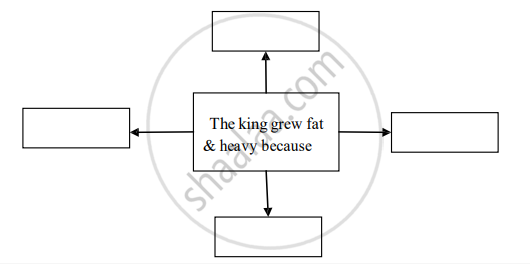
|
King Krishnadeva Raya would perform heavy exercises every morning. He regularly applied oil on his body and thereafter worked out till all the oil came out with the sweat. This was followed by a long ride on his horse. Once the king started leading a sedentary lifestyle, and he stopped exercising. He no longer went horse-riding either. The king overate and as a result grew fat and heavy. The king‟s temperament also underwent a sea change. Noticing this, the royal physicians cautioned the king against the ill effects of overeating and explained to him the risks posed by obesity. They advised the king to regulate his diet, exercise, and take care of his health. The repeated advice he got from the physicians to eat less made him so angry that one day he announced a reward for anyone who could find him an easy cure. But there was one condition: those who failed would have their heads off. None dared to advise the king in this regard. The situation became precarious and as usual Tenali Raman was approached by the courtiers for a remedy. Tenali heard the problem and assured the courtiers of a viable solution. The next day, an astrologer predicted that the king had only a month left to live. When the king came to know of this, he was furious. The astrologer was ordered by the king to be imprisoned for a month so that his prediction could be put to test and so the hapless forecaster was sent to prison. |
A3. Find out describing words from the passage for the words given below. [2]
- exercise - ...........
- lifestyle - ...........
- ride - ...........
- physician - ...........
A4. Do as directed. [2]
- King Krishnadeva Raya would perform heavy exercises every morning.
(Use ‘used to’) - They advised the king to regulate his diet. (Pick out the infinitive)
A5. What are the benefits of daily exercise? [2]
