Advertisements
Advertisements
प्रश्न
Long answer question:
Which blood vessel of the heart will have the maximum content of oxygen and why?
Advertisements
उत्तर
- Pulmonary vein carries the maximum content of oxygen.
- Pulmonary circulation moves deoxygenated blood from the heart to the lungs for oxygenation and it returns to the heart as oxygenated blood. Systemic circulation pushes the oxygenated blood from the heart towards various body parts (except lungs) and returns back to the heart as deoxygenated blood.
- Pulmonary vein is the only blood vessel that carries freshly oxygenated blood from the lungs to the heart for distribution to the body.
APPEARS IN
संबंधित प्रश्न
Put a tick mark (✓) against the correct alternative in the following statement:
The only artery which carries deoxygenated blood is :
Differentiate between the following pair of terms:
RBC and WBC.
Describe the functions of White blood cells.
Describe the functions of Blood.
The following simplified diagram refers to the outline plan of the circulation of blood in a mammal. Study the diagram and write the number and the name of the blood vessel in each case as mentioned ahead.

Several hours after a meal containing a lot of protein, which vessel will contain the highest concentration of urea?
Why are capillaries thin walled?
Given below is a simple diagram of the circulation of blood in a mammal showing the main blood vessels, the heart, lungs, and body tissues. The blood vessel labeled 6 contains deoxygenated blood and 2 the valve leading to it has three semi-lunar pockets.
(i) Name the blood vessels of organs marked by numbers 1 to 8.
(ii) What do you mean by the term ‘double circulation’ of blood in mammals?
(iii) What is diastole?
The diagrams given below show the cross-section of two kinds of blood vessels: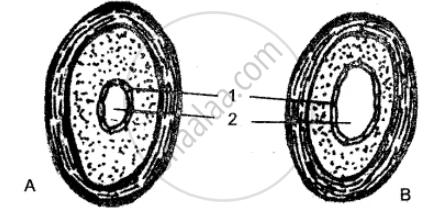
(i) Identify the blood vessels A and B. In each case give a reason to support your answer.
(ii) Name the parts numbered 1 and 2.
(iii) When are the sounds “LUBB” and “DUB” produced during a heartbeat?
(iv) Name the blood vessel that
(a) begins and ends in capillaries.
(b) supplies blood to the walls of the heart.
At the venous end of the capillary bed, the osmotic pressure is ______.
Which of the following are the pulse points of the lower limb?
I. Brachial
II. Radial
III. Posterior tibial
IV. Dorsalis pedis
V. Femoral
VI. Popliteal
Select the correct option.
