Advertisements
Advertisements
प्रश्न
Long answer question:
Describe the histological structure of the artery, vein, and capillary.
Advertisements
उत्तर
The three structural layers of a generalized blood vessel from innermost to outermost are the tunica interna (intima), tunica media, and tunica externa. Modifications in this basic design account for the five types of blood vessels and the structural and functional differences among the various vessel types. In the transverse section of an artery, three layers can be seen. They are:
T. S. of Artery, Vein and Capillary-

1. Tunica externa or tunica adventitia:
It is a thick, tough layer of collagen fibers.
2. Tunica media:
It is the middle layer made up of smooth muscle fibers and a network of elastic fibers. This thick muscular and elastic layer makes the arterial wall pulsatile.
3. Tunica interna or intima:
The innermost tunica interna is a single layer of flat compact endothelial cells surrounding the lumen. The angular margin around the lumen shows tessellations. Arterial lumen is devoid of valves and blood flows through it rapidly and with high pressure.
APPEARS IN
संबंधित प्रश्न
Sketch and label the T.S. of vein.
A blood vessel which carries blood back to the heart is ______.
Put a tick mark (✓) against the correct alternative in the following statement:
Pulmonary vein carries :
Fill in the blank with suitable word given below:
The instrument used to find out the blood pressure is known as __________________.
Which of the following statement is true (T) and which ones are false (F)? Mark T or F:
Blood group A has antigen A.
Name the instruments used for measuring pulse.
Given below is a diagrammatic representation of certain types of blood vessels in human body.
Identify the types of blood vessels numbered 1 to 5.
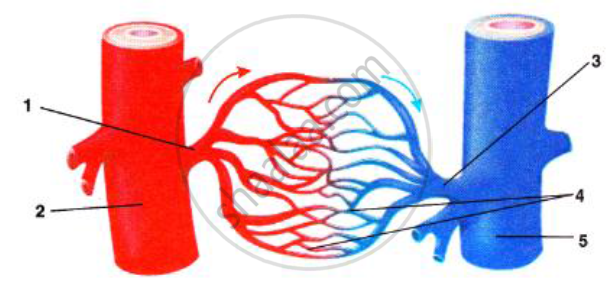
The blood vessel that supplies oxygenated blood to the liver.
Arteries and veins are connected by a network of extremely narrow tubes called:
The blood vessel without a mascular layer in its wall ______.
