Advertisements
Advertisements
प्रश्न
Let A = {9, 10, 11, 12, 13, 14, 15, 16, 17} and let f : A → N be defined by f(n) = the highest prime factor of n ∈ A. Write f as a set of ordered pairs and find the range of f
Advertisements
उत्तर
A = {9, 10, 11, 12, 13, 14, 15, 16, 17}
f : A → N
f(n) = the highest prime factor of n ∈ A
f = {(9, 3), (10, 5), (11, 11), (12, 3), (13, 13), (14, 7), (15, 5), (16, 2), (17, 17)}
Range = {3, 5, 11, 13, 7, 2, 17}
= {2, 3, 5, 7, 11, 13, 17}
APPEARS IN
संबंधित प्रश्न
The given figure shows a relationship between the sets P and Q. Write this relation
- in set-builder form.
- in roster form.
What is its domain and range?
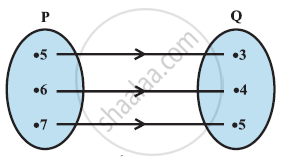
The relation f is defined by f(x) = `{(x^2,0<=x<=3),(3x,3<=x<=10):}`
The relation g is defined by g(x) = `{(x^2, 0 <= x <= 2),(3x,2<= x <= 10):}`
Show that f is a function and g is not a function.
If R = {(x, y) : x, y ∈ Z, x2 + y2 ≤ 4} is a relation defined on the set Z of integers, then write domain of R.
If R = [(x, y) : x, y ∈ W, 2x + y = 8], then write the domain and range of R.
Let A and B be two sets such that n(A) = 3 and n(B) = 2. If (x, 1), (y, 2), (z, 1) are in A × B, write A and B
Write the relation in the Roster Form. State its domain and range
R7 = {(a, b)/a, b ∈ N, a + b = 6}
Is the given relation a function? Give reasons for your answer.
s = {(n, n2) | n is a positive integer}
Let n(A) = m, and n(B) = n. Then the total number of non-empty relations that can be defined from A to B is ______.
In the ordered pair \((a,b)\), what are \(a\) and \(b\), respectively?
Why is \(R=\{(1,4),(2,3),(3,2),(4,1)\}\) not a function on \(A=\{1,2,3,4,5\}\)?
