Advertisements
Advertisements
प्रश्न
Let A(3, – 4), B(9, – 4), C(5, – 7) and D(7, – 7). Show that ABCD is a trapezium.
Advertisements
उत्तर
Let A(3, – 4), B(9, – 4), C(5, – 7) and D(7, – 7) are the vertices of a quadrilateral.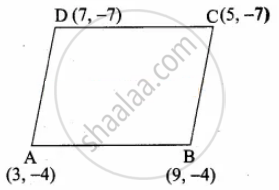
Slope of a line = `(y_2 - y_1)/(x_2 - x_1)`
Slope of AB = `(-4 + 4)/(9 - 3) = 0/6`= 0
Slope of BC = `(-7 + 4)/(5 -9)= (-3)/(-4) = 3/4`
Slope of CD = `(-7 + 7)/(7 - 5) = 0/2` = 0
Slope of AD = `(-7 + 4)/(7 - 3) = (-3)/4 = - 3/4`
The slope of AB and CD are equal.
∴ AB is parallel to CD. Similarly, the slope of AD and BC are not equal.
∴ AD and BC are not parallel.
∴ The Quadrilateral ABCD is a trapezium.
APPEARS IN
संबंधित प्रश्न
What is the slope of a line whose inclination with positive direction of x-axis is 90°
What is the slope of a line perpendicular to the line joining A(5, 1) and P where P is the mid-point of the segment joining (4, 2) and (–6, 4).
If the three points (3, – 1), (a, 3) and (1, – 3) are collinear, find the value of a
The line through the points (– 2, 6) and (4, 8) is perpendicular to the line through the points (8, 12) and (x, 24). Find the value of x.
Show that the given points form a parallelogram:
A(2.5, 3.5), B(10, – 4), C(2.5, – 2.5) and D(– 5, 5)
If the points A(2, 2), B(– 2, – 3), C(1, – 3) and D(x, y) form a parallelogram then find the value of x and y.
A quadrilateral has vertices at A(– 4, – 2), B(5, – 1), C(6, 5) and D(– 7, 6). Show that the mid-points of its sides form a parallelogram.
The slope of the line which is perpendicular to a line joining the points (0, 0) and (− 8, 8) is
Without using distance formula, show that the points (−2, −1), (4, 0), (3, 3) and (−3, 2) are vertices of a parallelogram
Find the equation of a line passing through the point of intersection of the lines 4x + 7y – 3 = 0 and 2x – 3y + 1 = 0 that has equal intercepts on the axes.
