Advertisements
Advertisements
प्रश्न
Length and breadth of a rectangular sheet of paper are 20 cm and 10 cm, respectively. A rectangular piece is cut from the sheet as shown in the following figure. Which of the following statements is correct for the remaining sheet?
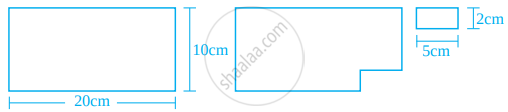
विकल्प
Perimeter remains same but area changes.
Area remains the same but perimeter changes.
Both area and perimeter are changing.
Both area and perimeter remain the same.
Advertisements
उत्तर
Perimeter remains same but area changes
Explanation:
Perimeter of rectangular sheet = 2 × (Length + Breadth)
= 2 × (20 + 10)
= 2 × 30
= 60 cm
∴ A × Breadth = 200 cm2 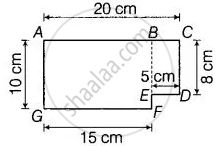
Now, perimeter of rectangular sheet after cutting the rectangular piece
= Sum of all sides
= 20 + 8 + 5 + 2 + 15 + 10
= 60 cm
Area = Area of rectangle ABFG + Area of rectangle BCDE
= (Length × Breadth) + (Length × Breadth)
= (15 × 10) + (5 × 8)
= 150 + 40
= 190 sq cm
Hence, perimeter remains the same but area changes after cutting the piece.
APPEARS IN
संबंधित प्रश्न
Find the perimeter of a rectangle whose:
length = 8 m and breadth = 80 cm
Find the perimeter of a regular hexagon of side 6.5 cm.
The side of a square is 3.6 cm; find its perimeter.
Sanju completes 12 rounds around a square park every day. If one side of the park is 120 m, find out in kilometres and metres the distance that Sanju covers daily.
A game requires its players to run around a square playground. Each side of the playground is 20 m long. One player took 5 rounds around the playground. How many metres did he run altogether?
Look at the figures on the sheet of graph paper. Measure their sides with the help of the lines on the graph paper. Write the perimeter of each in the right box.

- Perimeter of rectangle ABCD = ______ cm.
- Perimeter of rectangle EFGH = ______ cm.
- Perimeter of square PQRS = ______ cm.
- Perimeter of rectangle STUV = ______ cm.
The area of a rectangular field is 1600 sq m. If the length of the field is 80 m, find the perimeter of the field.
Find the cost of fencing a rectangular park of length 175 m and breadth of 125 m at the rate of ₹ 12 per metre.
A rectangle has length 15 cm and breadth 9 cm. What is its perimeter?
The perimeter of a rectangle is 60 m. What is the sum of its length and breadth?
