Advertisements
Advertisements
प्रश्न
Label the parts of the DNA in the diagram given below. Explain the structure briefly.

Advertisements
उत्तर
DNA is the hereditary material as it contains genetic information. DNA is a large molecule, consisting of millions of nucleotides. Each nucleotide consists of three compounds.
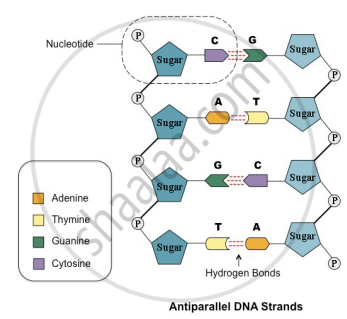
Nucleotides in a DNA
(a) A sugar molecule – Deoxy Ribose sugar
(b) A nitrogenous base [Purines and Pyrimidines]
- Purines (Adenine and Guanine)
- Pyrimidines (Cytosine and Thymine)
(c) A phosphate group Nucleoside and Nucleotide:
Nucleoside = Nitrogen base + sugar
Nucleotide = Nucleoside + Phosphate
The nucleotides are formed according to the purines and pyrimidines present in them.
APPEARS IN
संबंधित प्रश्न
State whether the following sentence is true or false:
Each spiral of the DNA has 12 nucleotides.
Choose the correct answer :
RNA has uracil instead of ____________
Write the functional activity of the following structure:
DNA
The ______ units form the backbone of the DNA.
Match the Column I with Column II and select the correct option.
| List-I | List-II | ||
| i. | Ribozyme | a. | Lac operon |
| ii. | Friedrich Miescher | b. | DNS as genetic material |
| iii. | Alfred Hershey and Martha Chase | c. | Catalytic RNA molecule |
| iv. | Francois-Jacob | d. | DNA is acidic substance |
In glycolysis how many NADH molecules are produced during the conversion of one glucose molecule to yield two molecules of pyruvate?
What is the pitch (vertical rise per complete turn) of the DNA double helix?
