Advertisements
Advertisements
प्रश्न
Justify the following reaction as a redox reaction.
\[\ce{2Na_{(s)} + S_{(s)} -> Na2S_{(s)}}\]
Find out the oxidizing and reducing agents.
Advertisements
उत्तर
- A redox reaction can be described as electron transfer, as shown below:
\[\ce{2Na_{(s)} + S_{(s)}->2Na^+ + S^2-}\] - Charge development suggests that each sodium atom loses one electron to form Na+ and the sulphur atom gains two electrons to form S2–. This can be represented as follows:
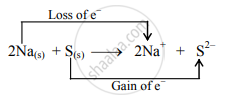
- When Na is oxidized to Na2S, the neutral Na atom loses electrons to form Na+ in Na2S while the elemental sulphur gains electrons and forms S2– in Na2S.
- Each of the above steps represents a half-reaction which involves electron transfer (loss or gain).
- The sum of these two half-reactions, or the overall reaction, is a redox reaction.
- An oxidizing agent is an electron acceptor, and hence, S is an oxidizing agent. A reducing agent is an electron donor, and hence, Na is a reducing agent.
APPEARS IN
संबंधित प्रश्न
Choose the correct option.
The coefficients p, q, r, s in the reaction \[\ce{{p}Cr2O7^{2Θ} + {q}Fe^{2⊕}->{r}Cr^{3⊕} + {s}Fe^{3⊕} + H2O}\] respectively are:
Choose the correct option.
Oxidation number of carbon in H2CO3 is
Choose the correct option.
Which is the correct stock notation for manganese dioxide?
Choose the correct option.
The process \[\ce{SO2->S2Cl2}\] is
Calculate the oxidation number of the underlined atom.
H2SO4
Calculate the oxidation number of the underlined atom.
H2S4O6
Justify that the following reaction is redox reaction; identify the species oxidized/reduced, which acts as an oxidant and which acts as a reductant.
\[\ce{I2_{(aq)} + 2S2O^{2-}_{3(aq)}->S4O^{2-}_{6(aq)} + 2I^-_{ (aq)}}\]
What is oxidation?
Identify the following pair of species is in its oxidized state.
Mg/Mg2+
Identify the following pair of species is in its oxidized state?
Cu/Cu2+
Identify the following pair of species is in its oxidized state?
\[\ce{O2/O^2-}\]
Identify the following pair of species is in its oxidized state?
Cl2/Cl−
Provide the stock notation for the following compound:
Tl2O
Provide the stock notation for the following compound:
FeO
Provide the stock notation for the following compound:
MnO
Which of the following is NOT an example of redox reaction?
In the complex [Co(en)3]Cl3, ____________.
Identify the strongest oxidising agent.
\[\ce{Na^+ + e^- -> Na}\]; E0 = −2.714 V
\[\ce{Pt^{2+} + 2e^- -> Pt}\]; E0 = +1.200 V
\[\ce{I2 + 2e^- -> 2I^-}\]; E0 = + 0.535 V
\[\ce{Co^{2+} + 2e^- -> Co}\]; 0 = −0.280 V
In which of the following, oxidation number of oxygen is +2?
What is the oxidation number of Carbon in K2C2O4?
The sum of oxidation number of all atoms in \[\ce{SnO^{2-}_3}\] ion is _______.
Carbon is present in highest oxidation number in ______.
The oxidation number of phosphorous in Ba(H2PO2)2 is ______.
What is the oxidation state of chlorine atom in perchloric acid?
Which of the following explanation is correct about the given below reaction?
\[\ce{Cr2O^2-_7 + H2O -> 2CrO^2-_4 + 2H+}\]
Which of the following statements are INCORRECT?
- All the transition metals except scandium form MO oxides which are ionic.
- The highest oxidation number corresponding to the group number in transition metals oxides is attained in Sc2B5 to Mn2B7.
- Basic character increases from V2B5 to V2B4 to V2B5.
- V2B4 dissolves in acids to give VO43– salts.
- CrO is basic but Cr2B5 is atmospheric.
Choose the correct answer from the options given below:
