Advertisements
Advertisements
प्रश्न
Is it possible that a force is acting on a body but still the work done is zero? Explain giving one example.
Advertisements
उत्तर
Yes, it is possible that a force is acting on a body but the work done is still zero. Following are the cases:
1. The displacement is zero.
2. The force and displacement are perpendicular to each other.
We know,
W = (F) (S) cos θ
Where,
(W) - Work done
(F) - Force
(S) - Displacement
(θ ) - Angle between force and displacement
From the equation itself, when the displacement is zero the work done is zero.
Example: No work is done when one pushes a wall that remains static even after pushing very hard.
When the force is perpendicular to the direction of motion, , and hence the work done is also zero.
Example - Work done by the force of gravity on a horizontally moving body is zero, because the force of gravity is perpendicular to the horizontal.
संबंधित प्रश्न
What are the two kinds of mechanical energy?
When is work said to be done by a force?
Express joule in terms of erg.
What are the units of (a) work, and (b) energy?
Write the formula for work done on a body when the body moves at an angle to the direction of force. Give the meaning of each symbol used.
Nm is the unit of .......
What is the work done against gravity when a body is moved horizontally along a frictionless surface?
A cricket ball is thrown up from the earth's surface. What happens to its P.E.
(a) during the motion
(b) at the highest point?
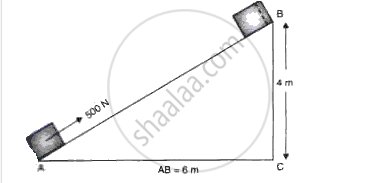
A block of mass 20 kg is pulled up a slope (fig.12) with a constant speed by applying a force of 500 N parallel to the slope. A and B are initial and final positions of the block.
(a) Calculate the work done by the force in moving the block from A and B.
(b) Calculate the potential energy gained by the block.
How fast should a boy weighting 30 kg run so that his kinetic energy is 375 joule?
A bullet is of mass 'm' g and is moving with a velocity 'v' m/s. Find the kinetic energy of the bullet when
(a) The mass is doubled,
(b) The velocity is tripled.
How is horse power related to the S. I. unit of power?
What is the difference between renewable and non-renewable resources?
A block of mass 30 kg is pulled up a slope, as shown in diagram with a constant speed, by applying a force of 200 N parallel to slope.
A and B are initial and final positions of block.

(i) Calculate the work done by force in moving the block from A to B.
(ii) Calculate P.E. gained by block. [g=10ms-2]
An electric motor pump is 60% efficient and is rated 2.5 H.P. Calculate the maximum load it can lift through a height of 10m in 8 sec. (1 H.P. = 750 W).
A uniform chain of length 2 m is kept on a table such that a length of 60 cm hangs freely from the edge of the table. The total mass of the chain is 4 kg. What is the work done in pulling the entire chain on the table?
