Advertisements
Advertisements
प्रश्न
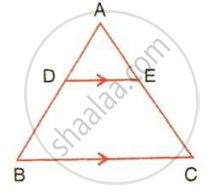
In triangle △ABC, AD : DB = 2 : 3, DE is parallel to BC.
Assertion (A): \[\frac{\mathrm{DE}}{\mathrm{BC}}=\frac{\mathrm{AD}}{\mathrm{BD}}=\frac{2}{3}\].
Reason (R): \[\frac{\mathrm{DE}}{\mathrm{BC}}=\frac{\mathrm{AD}}{\mathrm{AB}}=\frac{2}{5}\]
विकल्प
A is true, R is false.
A is false, R is true.
Both A and R are true and R is the correct reason for A.
Both A and R are true and R is the incorrect reason for A.
Advertisements
उत्तर
A is false, R is true.
Explanation:
Given,
AD : DB = 2 : 3
Let AD = 2x and DB = 3x.
From figure,
AB = AD + DB = 2x + 3x = 5x.
In Δ ADE and Δ ABC
⇒ ∠DAE = ∠BAC (Common angle)
⇒ ∠ADE = ∠ABC (Corresponding angles are equal)
⇒ ∠AED = ∠ACB (Corresponding angles are equal)
∴ ΔADE ∼ ΔABC (By AAA postulate)
We know that,
In similar triangles, corresponding sides are proportional (or in the same ratio).
∴ `(DE)/(BC) = (AD)/(AB)`
⇒ `(DE)/(BC) = (2x)/(5x) = 2/5`
∴ Assertion (A) is false, reason (R) is true.
