In the given figure, (\mathrm{DE} \parallel \mathrm{BC}) and (\mathrm{BD} = \mathrm{DC}). (i) Prove that DE bisects (\angle \mathrm{ADC}). (ii) If (\mathrm{AD} = 4 \cdot 5 \mathrm{~cm}
Advertisements
प्रश्न
In the given figure, \(\mathrm{DE} \parallel \mathrm{BC}\) and \(\mathrm{BD} = \mathrm{DC}\).
(i) Prove that DE bisects \(\angle \mathrm{ADC}\).
(ii) If \(\mathrm{AD} = 4 \cdot 5 \mathrm{~cm}, \mathrm{AE} = 3 \cdot 9 \mathrm{~cm}\) and \(\mathrm{DC} = 7 \cdot 5 \mathrm{~cm}\), find CE.
(iii) Find the ratio AD : DB.
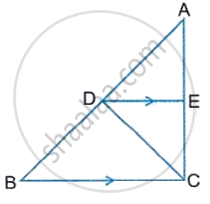
[Hint. (i) Since \[DE \parallel BC,\] we have
\[\frac{AD}{DB} = \frac{AE}{EC} \Rightarrow \frac{AD}{DC} = \frac{AE}{EC} \Rightarrow \frac{CE}{AE} = \frac{DC}{DA}.\]
Thus, \[DE\] divides \[CA\] in the ratio of other two sides.
(iii) \[\frac{AD}{DB} = \frac{AD}{DC} = \frac{AE}{EC}.\]]
Advertisements
उत्तर
(i) Given: In $$\triangle \mathrm{ABC}$$, $$\mathrm{DE} \parallel \mathrm{BC}$$ and $$\mathrm{BD} = \mathrm{DC}$$.
To prove: $$\mathrm{DE}$$ bisects $$\angle \mathrm{ADC}$$.
Proof:
- By Basic Proportionality Theorem, a line drawn parallel to one side of a triangle divides the other two sides proportionally.
- In $$\triangle \mathrm{ABC}$$, $$\mathrm{DE} \parallel \mathrm{BC}$$, so $$\frac{\mathrm{AD}}{\mathrm{DB}} = \frac{\mathrm{AE}}{\mathrm{EC}}$$ [By Basic Proportionality Theorem]
- But $$\mathrm{BD} = \mathrm{DC}$$ [Given]
- $$\frac{\mathrm{AD}}{\mathrm{DC}} = \frac{\mathrm{AE}}{\mathrm{EC}}$$
- or, $$\frac{\mathrm{AE}}{\mathrm{EC}} = \frac{\mathrm{DA}}{\mathrm{DC}}$$
- In $$\triangle \mathrm{ADC}$$, the segment $$\mathrm{DE}$$ divides the opposite side $$\mathrm{AC}$$ in the ratio of the other two sides $$\mathrm{DA}$$ and $$\mathrm{DC}$$. [By converse of Angle Bisector Theorem]
- Therefore, $$\mathrm{DE}$$ bisects $$\angle \mathrm{ADC}$$.
Hence proved.
(ii) Given: $$\mathrm{AD} = 4.5 \mathrm{~cm}$$
$$\mathrm{AE} = 3.9 \mathrm{~cm}$$
$$\mathrm{DC} = 7.5 \mathrm{~cm}$$
$$\mathrm{BD} = \mathrm{DC} = 7.5 \mathrm{~cm}$$
In $$\triangle \mathrm{ABC}$$, since $$\mathrm{DE} \parallel \mathrm{BC}$$:
$$\frac{\mathrm{AD}}{\mathrm{DB}} = \frac{\mathrm{AE}}{\mathrm{CE}}$$
$$\frac{4.5}{7.5} = \frac{3.9}{\mathrm{CE}}$$
$$\mathrm{CE} = \frac{3.9 \times 7.5}{4.5}$$
$$\mathrm{CE} = 6.5 \mathrm{~cm}$$
(iii) $$\frac{\mathrm{AD}}{\mathrm{DB}} = \frac{4.5}{7.5}$$
$$= \frac{45}{75}$$
$$= \frac{3}{5}$$
$$\mathrm{AD} : \mathrm{DB} = 3 : 5$$
