Advertisements
Advertisements
प्रश्न
In the given figure, AP is the bisector of ∠A and CQ is the bisector of ∠C of parallelogram ABCD. 
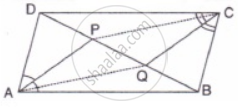
Prove that APCQ is a parallelogram.
Advertisements
उत्तर
Construction: Join AC
Proof:
∠BAP = `1/2`∠A ...( AP is the bisector of ∠A )
∠DCQ = `1/2`∠C ...( CQ is the bisector of ∠C )
⇒ ∠BAP = ∠DCQ ....(i)....[ ∠A = ∠R ( Opposite angles of a parallelogram.) ]
Now,
∠BAC = ∠DCA ....(ii)....[ Alternate angles since AB || DC ]
Subtracting (ii) from (i), We get
∠BAP - ∠BAC = ∠DCQ - ∠DCA
⇒ ∠CAP = ∠ACQ
⇒ AP || QC .....( Alternate angles are equal )
Similarly, PC || AQ.
Hence, APCQ is a parallelogram.
APPEARS IN
संबंधित प्रश्न
In the following figure, ABCD is a parallelogram. 
Prove that:
(i) AP bisects angle A.
(ii) BP bisects angle B
(iii) ∠DAP + ∠BCP = ∠APB
In the following figures, find the remaining angles of the parallelogram
The consecutive angles of a parallelogram are in the ratio 3:6. Calculate the measures of all the angles of the parallelogram.
PQR is a triangle formed by the adjacent sides PQ and QR and diagonal PR of a parallelogram PQRS. If in ΔPQR, ∠P : ∠Q : ∠R = 3 : 8 : 4, Calculate the measures of all the angles of parallelogram PQRS.
Opposite angles of a quadrilateral ABCD are equal. If AB = 4 cm, determine CD.
If PQRS is a parallelogram, then ∠P – ∠R is equal to ______.
In parallelogram FIST, find ∠SFT, ∠OST and ∠STO.

In the given parallelogram YOUR, ∠RUO = 120° and OY is extended to point S such that ∠SRY = 50°. Find ∠YSR.

