Advertisements
Advertisements
प्रश्न
In the following figure, PQ is a mirror, AB is the incident ray and BC is the reflected ray. If ∠ABC = 46°, then ∠ABP is equal to ______.

विकल्प
44°
67°
13°
62°
Advertisements
उत्तर
In the following figure, PQ is a mirror, AB is the incident ray and BC is the reflected ray. If ∠ABC = 46°, then ∠ABP is equal to 67°.
Explanation:

We know that, the angle of incidence is always equal to the angle of reflection.
∠ABP = ∠CBQ
i.e. a = b
Now, sum of all the angles on a straight line is 180°. ...[∵ ∠ABC = 46°, given]
∴ a + 46° + b = 180°
⇒ 2a = 180° – 46° ...[∵ a = b]
⇒ 2a = 134°
⇒ a = `134^circ/2` = 67°
∴ ∠ABP = 67°
APPEARS IN
संबंधित प्रश्न
One angle of a linear pair is a right angle. What can you say about the other angle?
There are six angles at a point. One of them is 45° and the other five angles are all equal. What is the measure of all the five angles?
In the given figure the angles ∠1 and ∠2 are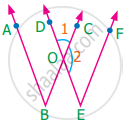
Find the value of x, y and z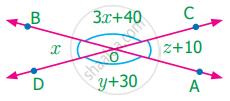
In the following figure, ∠ROS is a right angle and ∠POR and ∠QOS are in the ratio 1 : 5. Then, ∠QOS measures ______.
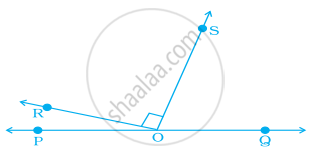
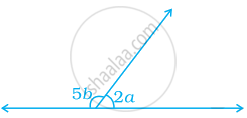
In the following figure, a = 40°. The value of b is ______.
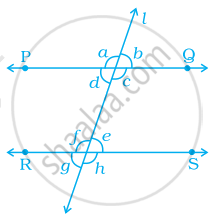
In the following figure, PQ || RS and a : b = 3 : 2. Then, f is equal to ______.
What is the type of other angle of a linear pair if one of its angles is obtuse?
